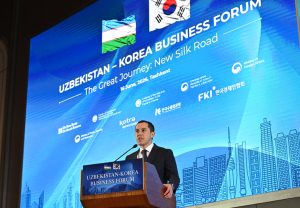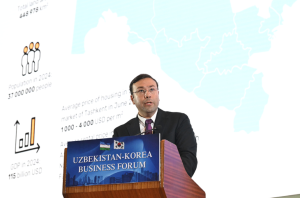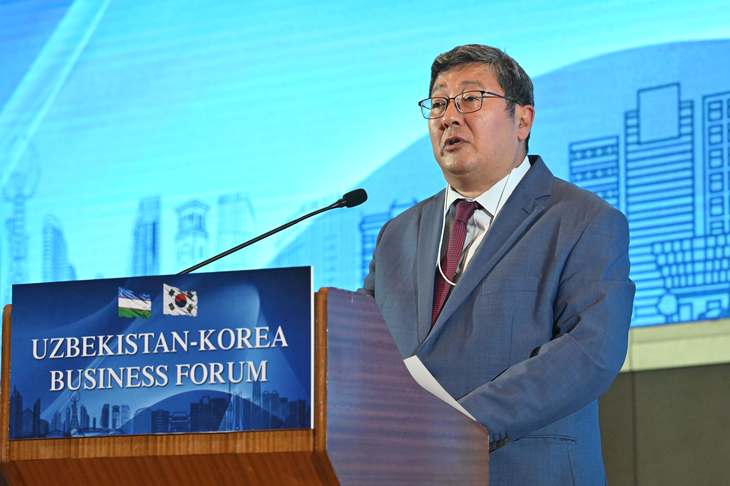
TASHKENT, Uzbekistan — South Korea has solidified its position as a pivotal partner for Uzbekistan in its ambitious modernization of transport infrastructure, announced Ilhomjon Abdugafarov, Uzbekistan’s Deputy Minister of Transport. His remarks came during the Korea-Uzbekistan Business Forum held recently in Tashkent.
“The Republic of Korea stands as one of Uzbekistan’s most vital and reliable allies in advancing modern infrastructure projects, integrating cutting-edge technologies, and fostering growth across the aviation, railway transport, and logistics sectors,” Abdugafarov emphasized, highlighting the strategic importance of this bilateral relationship.
A prime example of this collaboration is the significant modernization of Urgench International Airport, a key public-private partnership venture with Incheon International Airport Corporation.
“We consider this particular project a model of exemplary public-private partnership initiatives between our two nations,” he stated, underscoring its success.
Abdugafarov also shed light on ongoing preparations for the groundbreaking New Tashkent International Airport, a monumental project designed to transform into one of Central Asia’s foremost aviation hubs.
Uzbekistan is rapidly emerging as one of Central Asia’s fastest-growing economies, strategically positioning itself as a crucial regional manufacturing and logistics nexus, effectively connecting East Asia, the Middle East, and Europe.
“We actively seek the involvement of leading Korean firms renowned for their extensive expertise in airport construction, management, and digitalization for this strategically important project,” he affirmed.
In the burgeoning railway sector, Uzbekistan is making significant strides with plans for a high-speed rail connection linking Tashkent and Samarkand. This ambitious undertaking is bolstered by a substantial $3 million feasibility study grant from the Export-Import Bank of Korea.
“This project holds immense strategic value for enhancing connectivity between Tashkent and Samarkand, alleviating pressure on existing railway routes, and progressively developing advanced passenger transportation services,” Abdugafarov explained.
He further noted recent cooperative efforts with Korea concerning high-speed rolling stock. The initial pair of Korean-built electric trains have already commenced service on the critical Tashkent-Khiva route, marking a new era for Uzbek rail travel.
“These modern electric trains are significantly enhancing passenger convenience, substantially reducing travel times, and elevating overall service quality,” he added.
Looking ahead, Uzbekistan is actively exploring the acquisition of eight additional state-of-the-art electric train sets from Hyundai Rotem. These are earmarked for future high-speed services, expanding connectivity to key cities such as Andijan and Termez from Tashkent.
“We are confident that this forthcoming project represents a logical continuation of the robust and successful cooperation already established with the Republic of Korea,” Abdugafarov projected.
The Deputy Minister also revealed that the upcoming Central Asia-Republic of Korea Summit in Seoul later this year will serve as an invaluable platform to further broaden cooperation across transport, logistics, and critical infrastructure development.
Officials anticipate that this crucial summit will also foster new business partnerships, aligning with Uzbekistan’s strategic goal of deeper integration into regional and global supply chains.
“We firmly believe that deepening cooperation within the transport sector between Uzbekistan and the Republic of Korea will directly contribute to the creation of modern infrastructure, attract vital investment, and reinforce the economic interdependence between our thriving nations,” Abdugafarov concluded.
sanjaykumar