“Teach You a Lesson”: The Netflix K-Drama Sensation Tackling School Violence & Global Education Issues
By Lee Minji
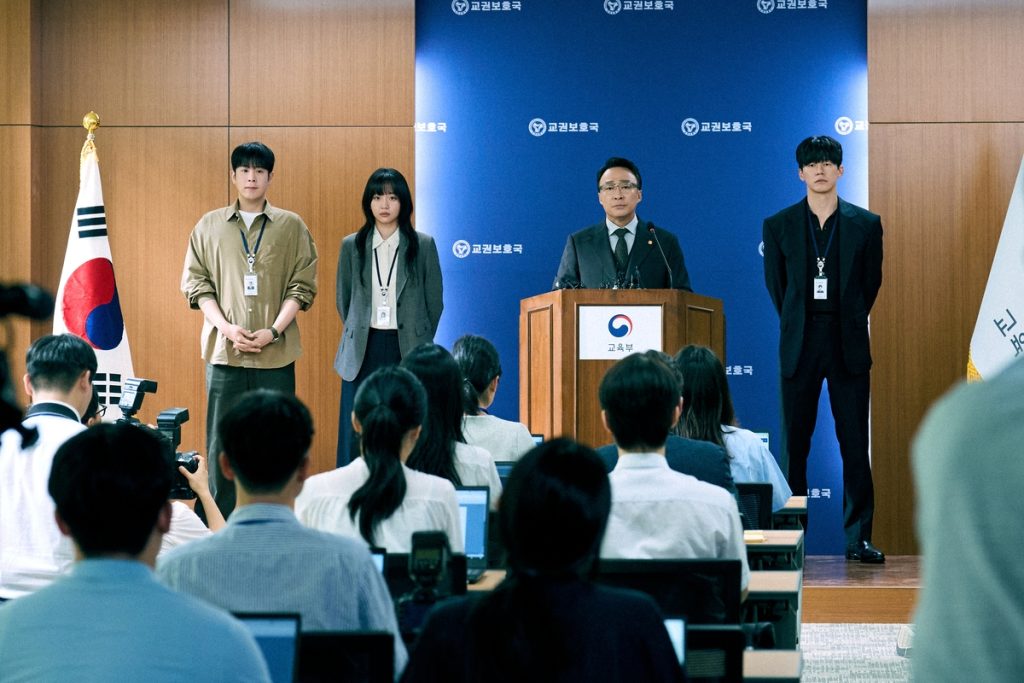
The gripping new Korean drama, “Teach You a Lesson,” adapted from the popular webtoon “Get Schooled,” is captivating global audiences. This compelling Netflix K-drama centers on the fearless trio from the fictional Education Rights Protection Bureau: lead inspector Na Hwa-jin (portrayed by Kim Mu-yeol), the resolute Im Han-rim (Jin Ki-joo), and the impactful Bong Geun-dae (Pyo Ji-hoon). Together, they embark on a mission to confront and “teach lessons” to school bullies and corrupt adults, bringing justice to the educational landscape.
Across its intense 10 episodes, this powerful K-drama fearlessly confronts a spectrum of dark societal issues plaguing the education system. From pervasive school violence and destructive teen gangs to drug use, widespread cheating scandals, gambling, and the complexities of overprotective parents, the series delivers cathartic — and at times violent — confrontations with its formidable villains, offering a unique take on justice.
From Webtoon to Global Hit: Why “Teach You a Lesson” Resonates Worldwide
Despite its distinctly South Korean setting and gritty, realistic portrayal of the nation’s education challenges, “Teach You a Lesson” has profoundly resonated with global audiences. This hit Netflix series soared to the top of Netflix’s non-English TV chart for an impressive second consecutive week, solidifying its status as a global K-drama phenomenon. It also ranked among the top 10 most-watched non-English shows in an astonishing 91 countries, highlighting its universal appeal.
Its critical acclaim is evident, with the series earning an impressive 83 percent rating among critics on the popular review platform Rotten Tomatoes. Audiences have also enthusiastically embraced the K-drama, granting it a remarkable 94 percent rating, underscoring its widespread approval and impact.
International viewers of “Teach You a Lesson” consistently highlight the series’ universal relatability. While deeply rooted in South Korean societal nuances, the drama’s core narrative about educational struggles and justice resonates powerfully with students and teachers worldwide. The solid performances by the entire cast, including the diverse array of compelling villains, have also garnered significant praise, enhancing the K-drama’s immersive experience.
This thought-provoking series refuses to shy away from uncomfortable truths. Instead, “Teach You a Lesson” delivers a powerful and unwavering message in every episode. It meticulously illustrates the profound consequences faced by both victims and perpetrators within the education system, while simultaneously shedding light on the systemic failures that frequently enable these issues to persist, making it a crucial watch for anyone interested in social commentary K-dramas.
Fans continue to laud the impactful K-drama. “It realistically portrays what teachers, students and parents across the world are experiencing everyday,” one audience member wrote on Rotten Tomatoes, emphasizing the drama’s global relevance.
“As a teacher, this series was pure dopamine. … Seeing students, parents, and even schools being held accountable in such an unconventional way was incredibly satisfying,” another user enthusiastically shared on Reddit, highlighting the show’s cathartic appeal.

Behind the Scenes: Cast & Crew Reflect on the Impact of the Korean Series
Jin Ki-joo, who expertly portrays the special forces soldier-turned-inspector Im Han-rim in the popular K-drama, echoed this sentiment. She attributes much of the series’ widespread popularity to the crystal-clear message it conveys, resonating deeply with viewers seeking justice.
“Victims should be able to find comfort and get back on their feet, while perpetrators should realize what they did wrong and reflect on their actions,” Jin explained to reporters in a recent group interview. “It seems like such an obvious principle, but things do not always unfold like that in reality, so it was good to see that clearly demonstrated in the drama ‘Teach You a Lesson’.” This statement reinforces the core themes of the globally acclaimed K-drama.
Kim Mu-yeol, delivering a powerful performance as lead inspector Na Hwa-jin, admitted his surprise at the K-drama’s extensive international appeal. He initially hadn’t anticipated the story resonating so strongly beyond South Korea’s borders.
“I remember getting a message from a teacher in Malaysia who had watched the series and was moved and comforted by it,” Kim Mu-yeol shared with reporters during a recent group interview. “I never imagined the ‘Teach You a Lesson’ story would connect with people across borders in this way, proving the universal impact of this remarkable Korean series.”

Addressing Controversy: The Deeper Message of “Teach You a Lesson”
Despite the immense hype surrounding this popular K-drama, “Teach You a Lesson” has also faced critical scrutiny. Some critics have pointed out that the series, despite tackling profoundly complex educational issues, occasionally leans on a more simplistic, fantasy-like approach to problem-solving within its narrative.
The core premise of the “Teach You a Lesson” series, which depicts inspectors employing direct, often violent, methods to discipline problematic students and adults, has been a source of controversy since its inception. Furthermore, the original “Get Schooled” webtoon had previously garnered backlash for certain racial and sexist depictions, a point of discussion around the K-drama adaptation.
Director Hong Jong-chan openly acknowledged these concerns surrounding the narrative’s approach. However, he expressed hope that the Korean series would ultimately be “meaningful” if it successfully sparks vital social discussions about education and justice.
“If there are viewers who have felt emotions similar to those of the victims, I hope they can find comfort through the drama,” Hong Jong-chan stated in an interview with reporters. He added, “I can’t speak about social systems, but if this ‘Teach You a Lesson’ series can open up a space for conversation about these critical issues, I think that alone would be meaningful,” underscoring the K-drama’s objective beyond mere entertainment.