
Record Foreign Investor Sell-Off: Samsung Electronics & SK hynix Lead ₩45 Trillion Kospi Withdrawal
In a significant market move, foreign investors executed a record-breaking ₩45 trillion (approximately $30 billion USD) sell-off of Kospi shares during May. This unprecedented monthly withdrawal from the South Korean benchmark stock index was primarily driven by strategic profit-taking following a robust rally in the nation’s leading semiconductor giants, Samsung Electronics and SK hynix.
Data from the Korea Exchange confirms that overseas investors net sold a substantial ₩44.71 trillion on the Kospi in May, establishing a new record for monthly foreign equity sell-offs. This figure significantly exceeded the prior record of ₩35.75 trillion, which was established just two months earlier in March.
This extensive foreign selling trend saw investors act as net sellers for an unbroken sequence of 16 trading sessions, spanning from May 7 through the month’s close. This marks the most prolonged foreign selling streak witnessed on the Kospi since a 17-session run between February 10 and March 4, 2009, a period when the South Korean stock market was grappling with the profound repercussions of the global financial crisis.
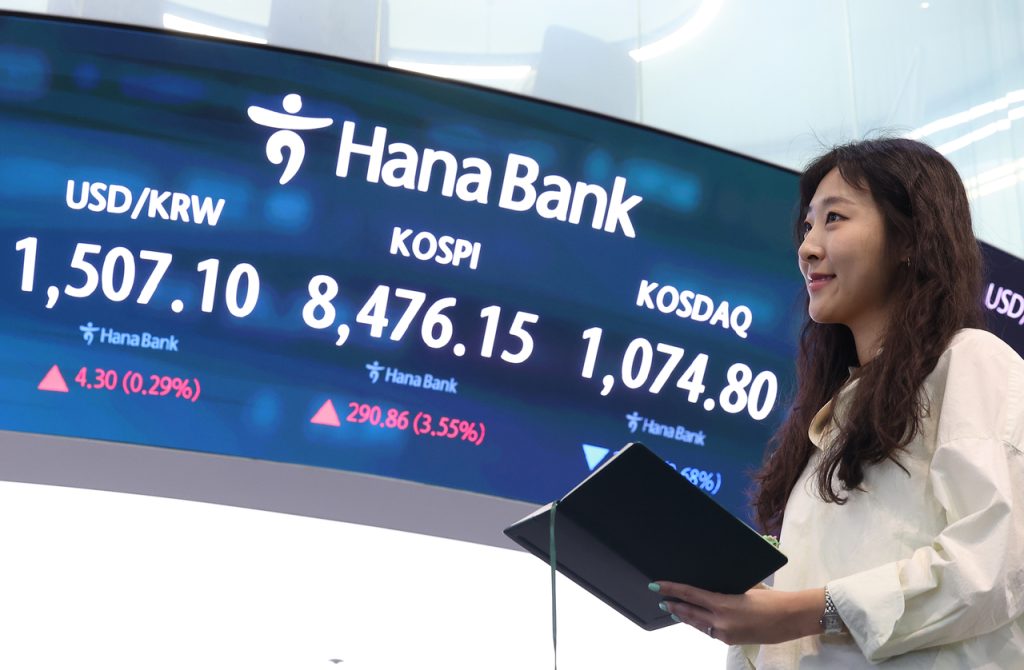
Market analysts widely interpret this unprecedented foreign sell-off as a calculated wave of profit-taking, coming on the heels of the Kospi’s impressive rally. Throughout May, the benchmark index soared by 28.45 percent, accumulating approximately 2,000 points to conclude trading on Friday at a historic high of 8,476.15.
Spearheading this remarkable market ascent were South Korea’s premier semiconductor giants, Samsung Electronics and SK hynix. Their respective shares witnessed substantial surges of 43.76 percent and 81.42 percent over the month, each reaching record high valuations in May, significantly bolstered by robust retail investor demand.
Ironically, these two powerhouse stocks, instrumental in propelling the benchmark’s gains, also became the primary targets for foreign investor selling.
SK hynix led foreign investors’ sell list with net sales reaching an astounding ₩20.72 trillion, while Samsung Electronics followed closely as the second-most sold stock, with net sales of ₩16.03 trillion.
Together, these two dominant South Korean chipmakers — Samsung Electronics and SK hynix — comprised a staggering 82 percent of the total net selling by foreign investors on the Kospi during this period.
Beyond the semiconductor sector, other significantly offloaded stocks included Hyundai Mobis, ranking third with net sales of ₩2.59 trillion. SK Square followed with ₩1.42 trillion in net sales, and Hyundai Motor saw ₩1.32 trillion in foreign divestment.
Market analysts largely attributed this substantial selling activity to strategic portfolio rebalancing rather than indicating a fundamental structural reduction in foreign exposure to Korean equities.
“The extensive selling observed primarily reflects calculated efforts to rebalance portfolio weightings following the rapid and significant gains recorded by Samsung Electronics and SK hynix, rather than stemming from any inherent concerns regarding their fundamental value,” commented Lee Jae-won, an analyst at Yuanta Securities.
Conversely, foreign investors simultaneously demonstrated increased confidence in South Korea’s secondary bourse, the Kosdaq, by significantly raising their stakes throughout May.
Offshore investors’ net purchases on the Kosdaq hit an unprecedented ₩2.84 trillion in May, establishing a new record and comfortably exceeding the previous high of ₩2.8 trillion set in July 2023.
Analysts largely attribute this surge in Kosdaq investment to heightened expectations that numerous Kosdaq-listed companies stand to benefit significantly from the impending launch of the state-backed National Growth Fund. This strategic fund is explicitly designed to channel a substantial portion of its capital toward innovative and high-growth companies listed on the Kosdaq.
Within the Kosdaq market, the fabless startup Fadu emerged as foreign investors’ top preference, attracting net purchases totaling ₩437 billion during May.
Following Fadu, other prominent foreign investment targets included battery material manufacturer Ecopro BM, with ₩155 billion in net purchases, and pharmaceutical company ABL Bio, which saw ₩125 billion.
“Anticipation has significantly increased that the National Growth Fund’s launch will substantially expand capital inflows into cutting-edge industries, including pharmaceuticals, biotechnology, robotics, and aerospace,” stated Lee Kyung-min, an analyst at Daishin Securities.
“Consequently, the Kosdaq, characterized by its higher concentration of growth-oriented stocks, has been able to capitalize more effectively on this policy-driven momentum compared to the broader Kospi index.”
silverstar


