The proposed 2026 wage agreement at **Samsung Electronics** is currently facing significant opposition from employees within its **consumer electronics and mobile division**, specifically the **Device eXperience (DX) division**.
Union leaders allege that management has heavily biased the tentative deal towards the company’s highly profitable **memory chip business**, effectively sidelining and neglecting **Samsung’s finished-product workers** in the DX division.
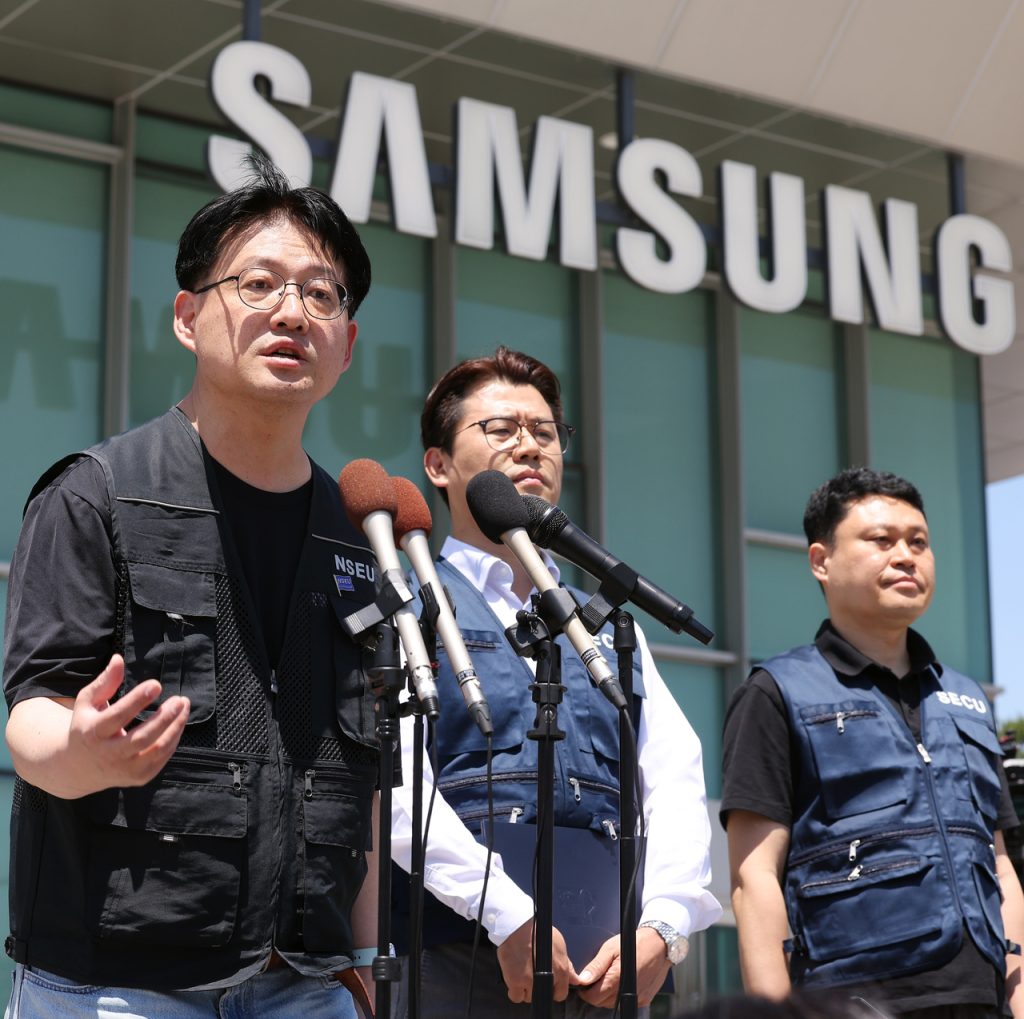
In a powerful demonstration, the **Suwon branch of the National Samsung Electronics Union (NESU)** and the **Samsung Electronics Donghaeng Labor Union**, predominantly representing **Device eXperience (DX) employees**, convened a press conference on Friday. Held outside **Samsung Digital City in Suwon, Gyeonggi Province**, they unequivocally vowed to actively campaign against the controversial wage agreement.
For clarity, the **Device eXperience (DX) division** is responsible for **Samsung’s entire finished-product portfolio**, encompassing globally recognized products such as **smartphones, televisions (TVs), and home appliances**.
The unions strongly asserted that the ongoing **wage negotiations** have been “effectively reduced to a **bonus deal for the memory business**.” They further emphasized that the proposed agreement exhibits a distinct bias towards the **Device Solutions (DS) division**, which handles **Samsung’s lucrative semiconductor business**, at the expense of its dedicated **DX employees**, who feel increasingly marginalized.
Central to this growing **wage dispute** is **Samsung’s controversial performance-based pay system**. Union representatives argue that the current framework disproportionately benefits specific business units, allowing them to reap significantly greater rewards, even though other divisions, like DX, provided crucial stability and contributions during periods when the **semiconductor chip business** faced considerable market pressure.
Lee Ho-seop, who leads the **NESU’s Suwon branch**, highlighted the disparity: “The **DX division** was instrumental in maintaining the company’s stability with consistent **operating profit** during times when the **semiconductor sector was struggling**.” He added, “Now that overall performance has rebounded, it is incredibly difficult to justify a system where only one segment disproportionately enjoys the benefits.”
Lee clarified, “This isn’t merely a demand for higher wages. **DX employees** are seeking rightful recognition for their significant contributions and sacrifices. While **Samsung Electronics** operates as a unified company, its existing **bonus system** is unfortunately creating a deep divide and fostering resentment among its various divisions.”
Furthermore, the unions stated that the proposed **tentative wage agreement** fails to address their core demands, which include drastically improved **transparency in bonus calculations** and the complete **removal of bonus caps**. They also heavily criticized the company’s “stopgap” strategy of offering special bonuses, noting a persistent lack of clear explanations regarding **operating profit calculation** and the overall process of **reward allocation**.
Adding another layer of controversy, the proposed deal mandates an agreement for both **labor and management to withdraw existing civil and criminal lawsuits** filed against each other. This particular clause has ignited considerable suspicion and concern among a segment of **Samsung employees**.
Lee questioned, “Employees are now asking if the company strategically utilized these **lawsuits as leverage** during the wage negotiations.” He emphasized, “Management must provide a transparent and unequivocal explanation for the **withdrawal of these lawsuits**.”
According to union officials, palpable signs of discontent are evident across **Samsung’s internal message boards**, where **DX employees** are actively posting emotionally charged phrases like “mourning” and “DX being passed over.” These expressions clearly convey deep anger and frustration over what they perceive as their division’s systemic marginalization and oversight.
A union official commented on the unprecedented scale of the reaction, stating, “For an organization that has historically maintained a quiet demeanor, this level of widespread **open protest** unequivocally demonstrates the profound depth of **employee frustration**.”
This growing backlash coincides directly with a dramatic surge in **Samsung union membership**. **Koo Jung-hwan**, the secretary-general of the **Donghaeng Labor Union**, revealed in a statement that their union alone remarkably attracted **10,000 new members** in a single day, underscoring the widespread dissatisfaction.
Koo further accused the leadership of the larger joint union of attempting to unfairly **exclude Donghaeng members** from participating in the crucial ongoing **vote on the tentative agreement**. He suggested this move stemmed from concerns about how the influx of new members might impact the voting outcome.
Koo sternly declared, “The **exclusion of Donghaeng members**, who were integral participants in the negotiations as part of the joint bargaining group, is not only **unlawful** but also a blatant **abuse of discretion**.” He warned, “Should they proceed with this exclusion, we are prepared to pursue every available **legal remedy**, including lodging a formal request for **corrective action with the Labor Relations Commission**.”
Echoing this sentiment, Lee also affirmed that **voting rights must be unequivocally guaranteed for all union members**, irrespective of whether their specific union formally aligns with the joint bargaining group.
He referenced a prior situation: “There’s a clear **precedent where the DX union participated in a vote** on a tentative agreement, despite not being an official component of the joint bargaining group.” He concluded, “It is illogical and unacceptable to **deny voting rights** on that same basis now.”
Lee further cautioned that if **Donghaeng members** are subsequently recognized as **eligible voters**, the overall **legitimacy of the current ongoing vote** could be significantly challenged and potentially invalidated.
The unions additionally directed criticism towards **Roh Tae-moon**, the president and head of the **DX division**, accusing him of a profound failure to adequately **communicate with employees** throughout the months-long **wage negotiations**.
Lee stated, “For months, **DX employees** have endured considerable disappointment and frustration, yet **President Roh Tae-moon** has not engaged with them in any meaningful way.” He urged, “Upon his return to Korea, he must immediately meet with employees to address their concerns and collaboratively strategize on how to effectively **restore morale** within the division.”
Union officials emphasized that the widespread anger among **DX workers** transcends mere dissatisfaction with the **size of the payout**.
A union official lamented, “Outside observers often incorrectly assume that all **Samsung Electronics employees** receive bonuses amounting to hundreds of millions of won.” He added, “Now, our employees are frequently in the awkward position of having to explain to their families and friends that these media headlines simply do not accurately reflect their actual **paychecks**.”
yeeun