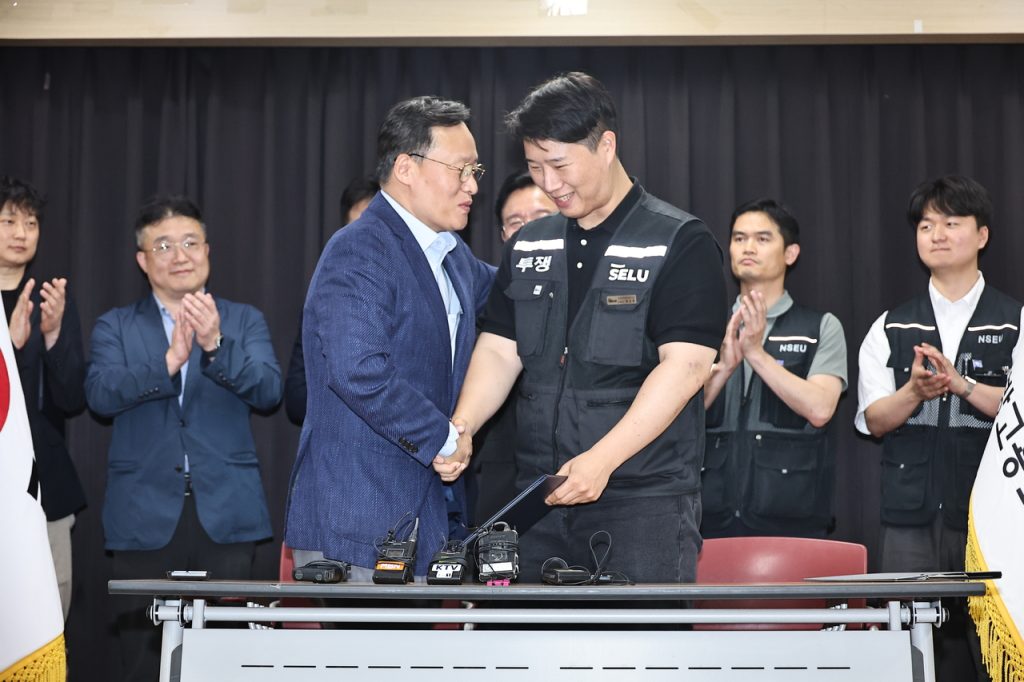
Samsung Electronics and its labor union have reached a significant understanding, agreeing to withdraw all legal complaints stemming from a recent strike. This crucial step includes the retraction of allegations concerning employees creating and circulating a list of colleagues who did not participate in the walkout.
This pivotal agreement, aimed at fostering improved labor relations and a healthier workplace culture, was formally documented in the minutes of a labor-management meeting dedicated to performance-based pay, as confirmed by industry sources on Friday.
The comprehensive document was finalized after both parties reached a tentative agreement last Wednesday regarding Samsung’s employee incentive scheme. It outlines the specific details of the deal and crucial follow-up measures, marking a concerted effort by both management and the union to mend strained relations.
The dispute originated on April 9, when Samsung initiated a police complaint. The complaint cited allegations that certain employees had used co-workers’ personal information to compile and distribute a “blacklist” indicating their union membership status.
Just a week later, the company filed an additional complaint. This followed the identification of an employee suspected of unlawfully collecting a substantial volume of employee data and sharing it without authorization.
The Hwaseong Dongtan Police Station in Gyeonggi Province, actively investigating the case, conducted search operations at Samsung’s Giheung campus on May 8 and again on May 18 as part of their ongoing inquiry.
While Samsung’s decision to withdraw the complaints is a significant gesture, it does not automatically lead to the immediate closure of the case. Alleged violations of the Personal Information Protection Act or the Trade Union and Labor Relations Adjustment Act are not typically offenses that can be dropped solely at the complainant’s request.
Nevertheless, this shift in Samsung’s official position is expected to be a factor considered by investigators, prosecutors, and potentially by the court should the case proceed to trial.
This development follows the labor union’s tentative acceptance of the proposed wage deal, which consequently led to the suspension of its strike action.
Beyond the legal matters, Samsung and the union also solidified the framework for calculating the company’s overall performance incentive schemes for employees.
For the Device Solutions (DS) division, which oversees Samsung’s critical chip business, the union will formally determine the basis for calculating the OPI (Overall Performance Incentive) pool. Practically, the payout is anticipated to be set at 10 percent of operating profit, directly linked to a performance metric mutually agreed upon by management and labor representatives.
Meanwhile, for the Device eXperience (DX) division, responsible for finished products like Samsung smartphones and home appliances, employees within each business unit will participate in a vote to select their preferred incentive formula. The DX division offers a choice between 10 percent of operating profit and 20 percent of economic value added (EVA).
Furthermore, Samsung and the union confirmed a crucial detail: company shares, valued at 6 million won (approximately $4,000) per person, allocated to DX division employees under this latest agreement, will not be subject to any restrictions on their sale timing. This ensures greater flexibility for employees receiving these shares.
This particular arrangement for the newly granted shares contrasts with a separate, existing stock-based special management performance bonus for DX employees, which does include specific limitations on when shares can be sold.
yeeun