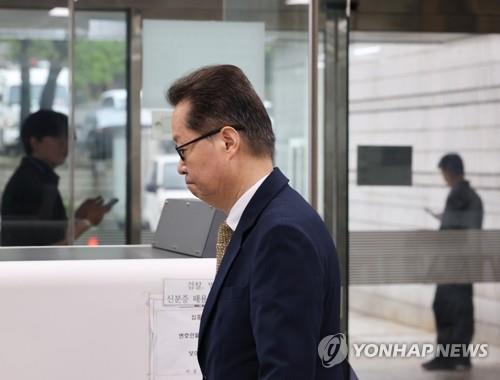
Former KTV Head Lee Eun-woo arrived at the Seoul Central District Court at 9:16 a.m. for his arrest warrant hearing, which commenced at 10 a.m. These legal proceedings relate to significant accusations from his time leading the public broadcaster.
Lee Eun-woo is specifically accused of directing KTV to repeatedly broadcast reports asserting the legitimacy of Yoon’s martial law. This alleged directive spanned approximately 10 days following the declaration on Dec. 3, 2024. Simultaneously, he faces charges of suppressing and deleting news reports that were critical of the emergency measure.
KTV, the broadcasting service at the center of this controversy, is operated by the Korea Policy Broadcasting Service, an entity affiliated with the Ministry of Culture, Sports and Tourism.
The second comprehensive special counsel team, led by Kwon Chang-young, formally requested an arrest warrant for Lee on Monday, citing charges of propaganda for insurrection. This marks a crucial development, as it is the first attempt by Kwon’s team to secure custody of a suspect since its inauguration in February.
Separately, Lee Eun-woo was previously indicted last December by another special counsel team, this one led by Cho Eun-suk. He is currently standing trial on charges of abuse of authority for allegedly ordering the removal of broadcast captions that featured politicians’ remarks describing the martial law declaration as illegal and unconstitutional.
During the earlier investigation, Cho’s team had cleared Lee of the insurrection propaganda charges. Their decision was based on the judgment that the alleged offense occurred after the martial law had been lifted, and they also considered that excessive punishment could potentially stifle freedom of the press.
In the ongoing trial handled by Cho’s team, a five-year prison term has been demanded for Lee Eun-woo, with the sentencing hearing set for June 26.
Against this complex legal backdrop, some prominent legal experts are now arguing that Kwon’s team’s recent request for an arrest warrant could be tantamount to a “double indictment.” This concern stems from the fact that it involves reinvestigating a case for which an indictment has already been made.