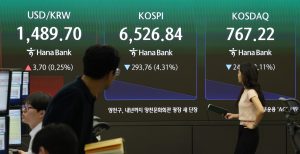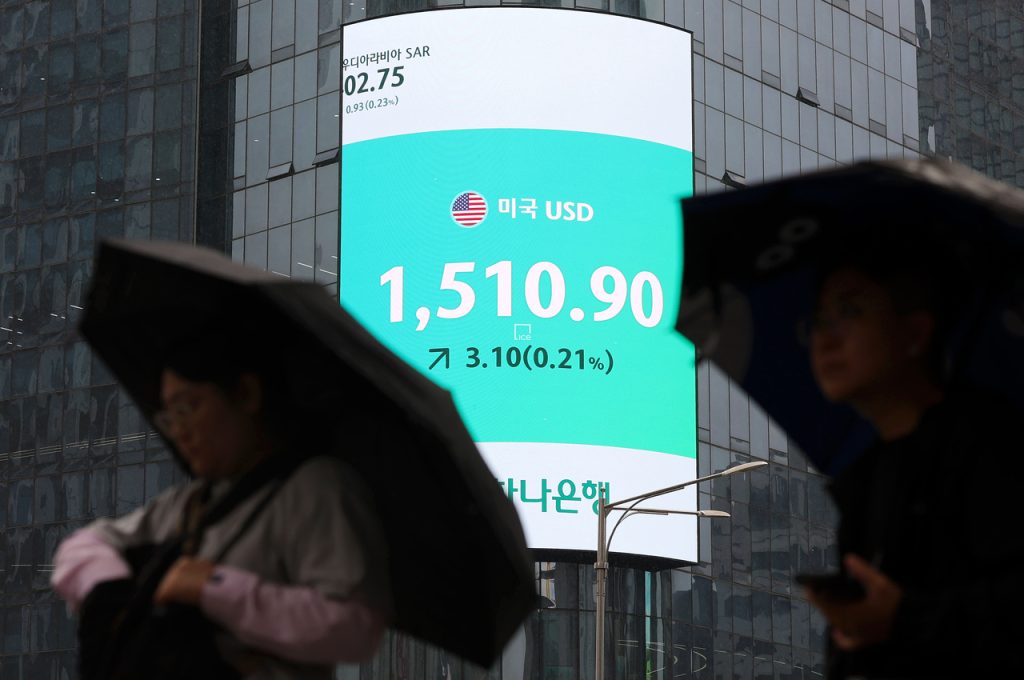
The South Korean won experienced a significant depreciation on Wednesday, weakening past the 1,510 per dollar level in intraday trading. This marked its lowest point in over a month, driven primarily by a surge in US Treasury yields and substantial foreign selling in local equities, which collectively pressured the Korean currency.
Opening at 1,509 per dollar in onshore trading, the won-dollar exchange rate quickly moved beyond the 1,510 threshold. It further declined to an intraday low of 1,513.4 before stabilizing around 1,512.5 by 2 p.m. This breach of the 1,510 level during daytime trading was the first instance since April 6, highlighting renewed volatility.
Previously, the Korean won had shown signs of recovery, stabilizing in recent weeks after a period of volatility triggered by the Iran war. The average monthly won-dollar exchange rate had improved, easing from 1,492.5 in March to 1,485 in April.
However, the currency is now facing renewed pressure this month. Persistent geopolitical tensions, escalating US bond yields, and considerable foreign capital outflows from Korean equities are collectively fueling a robust demand for the US dollar.
The latest won selloff was significantly influenced by a sharp increase in long-term US Treasury yields. Overnight, the yield on the 30-year US Treasury bond briefly approached 5.2 percent, reaching its highest level since 2007, prior to the global financial crisis. Similarly, the benchmark 10-year Treasury yield climbed to 4.687 percent, the highest recorded since January.
These higher Treasury yields broadly strengthened the dollar. The dollar index, which measures the greenback’s value against six major currencies, climbed to approximately 99.43 on Wednesday morning, marking its strongest point in about a month.
Adding further downward pressure on the won was the substantial foreign investor selling in Korean equities. As offshore investors divest from local stocks, they convert the proceeds into dollars, intensifying demand for the greenback and weakening the won.
Foreign investors net sold a staggering 35.42 trillion won (approximately $23.5 billion) worth of Kospi shares from May 1 through Tuesday. On Wednesday alone, they offloaded an additional 2.5 trillion won, which contributed to the benchmark Kospi index falling 1.56 percent by 2 p.m.
During trading, the Kospi index briefly dipped below the 7,100 mark, hitting an intraday low of 7,053.84.
Min Kyung-won, an economist at Woori Bank, commented on the situation, stating, “While the selloff in US semiconductor stocks has somewhat eased, rising long-term Treasury yields continue to exert pressure on emerging-market equities.”
He further elaborated, “Heightened global uncertainty is also bolstering demand for the dollar even among reserve currencies. This inevitably means that emerging-market currencies, particularly the Korean won, are confronting intensified pressure.”
silverstar