
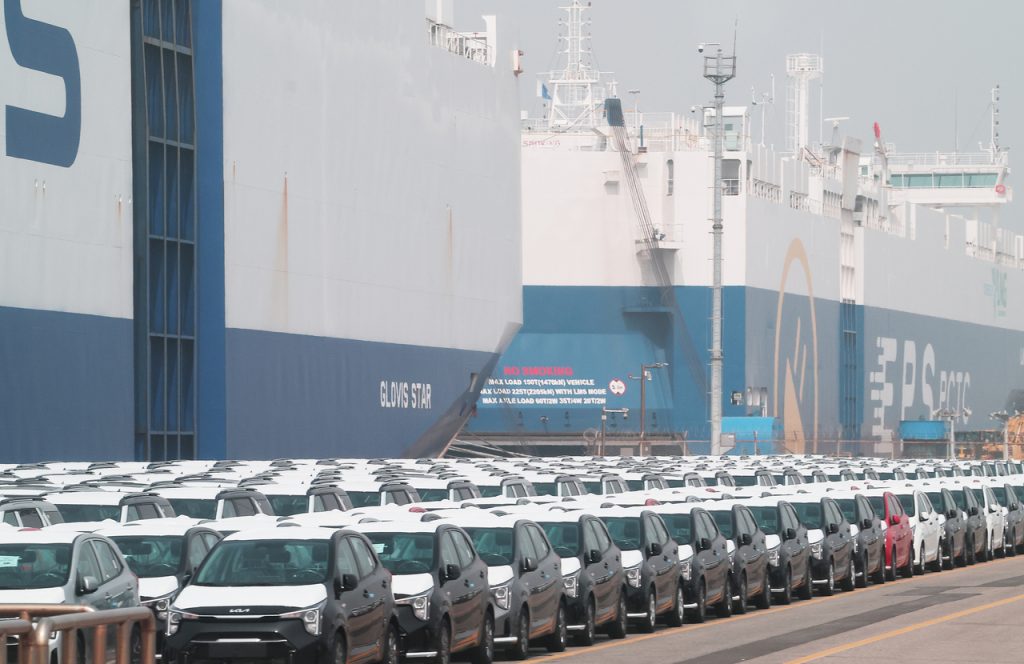
South Korea’s automotive exports experienced a notable decline in April, falling over 5% year-on-year, primarily driven by a significant downturn in shipments to the Middle East amidst an ongoing geopolitical crisis in the region, according to government data released Wednesday.
The Ministry of Trade, Industry and Energy reported that the total value of automobile exports for the month reached $6.17 billion. This figure represents a 5.5% decrease compared to the same period last year, highlighting challenges faced by the Korean auto industry.
While outbound vehicle shipments saw growth to North America (+2.4%), Latin America (+23.7%), and Oceania (+20.1%), these gains were overshadowed by a sharp 38.7% plunge in exports to the Middle East, exacerbated by the ongoing conflict between the United States and Iran. Additionally, exports to the European Union decreased by 13.1%, and shipments to the broader Asian market fell considerably by 31.7%.
In a brighter spot for the South Korean automotive sector, eco-friendly vehicle exports demonstrated robust growth, increasing by 13.5% to reach $2.52 billion in April. This surge was predominantly fueled by a remarkable 139.7% rise in electric vehicle (EV) sales and a substantial 135.8% jump in hybrid car exports, underscoring a global shift towards greener transportation solutions.
Domestically, a total of 152,000 vehicles were sold last month, showing a modest 0.7% increase, indicating stable local market demand.
However, domestic automobile production faced challenges, contracting by 6.1% year-on-year to 362,000 units. This decline was attributed to ongoing supply chain disruptions affecting certain auto parts and consumers delaying purchases in anticipation of new and facelifted models from major vehicle manufacturers.
Despite the overall production dip, several key players saw gains. GM Korea Co., the South Korean arm of General Motors Co., reported a 15.4% increase in production, alongside KG Mobility Corp. with an 8.6% rise, and Kia Corp. which saw a modest 0.5% gain. Conversely, industry giant Hyundai Motor Co. experienced a 16.2% decline in production, while Renault Korea’s output significantly decreased by 32.3%.


