By Lee Minji
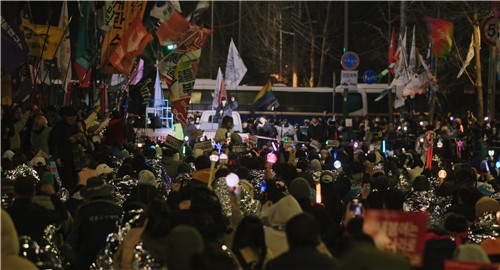
Two years ago, a remarkable gathering unfolded on a freezing winter night at Namtaeryeong, a quiet hill separating Seoul and Gyeonggi Province. This remote location, typically frequented only by passing cars and a lone convenience store, became the backdrop for an unprecedented rally. Farmers, seasoned activists, converged with young women in their twenties and thirties, forging an unlikely alliance that night.
The compelling documentary, “The Longest Night: Namtaeryeong,” vividly chronicles this extraordinary solidarity. It captures the powerful bond formed between tractor-driving farmer activists and young women, many armed with K-pop light sticks, as they protested together through the biting cold.
This pivotal, 28-hour peaceful demonstration took place on December 21st, just weeks after the brief martial law imposition by former President Yoon Suk Yeol on December 3rd. The film provides crucial context to this significant moment in South Korean history.
Through a rich tapestry of interviews with various participants—some choosing to remain anonymous or identified by their online personas—the documentary explores the event’s profound repercussions and how the Namtaeryeong experience reshaped their lives.
Highlighting the critical role of social media, particularly X (formerly Twitter), in disseminating information and mobilizing participants, the film ingeniously integrates actual posts from young users. This innovative approach offers a dynamic real-time perspective on how the events of that night unfolded.
The documentary’s swift editing of X posts, combined with the distinct “bubbly” sounds of new messages appearing on timelines, masterfully maintains viewer engagement throughout its nearly two-hour run time.
The narrative begins by introducing a young woman known for consistently bringing her “introvert” flag to protests, a symbol of solidarity for fellow introverted attendees.
It then expands to feature other key figures, including a young woman farmer who initially reported on police blocking farmer activists, and another young woman renowned for curating vibrant K-pop music playlists for rallies and creating “What’s in my bag” videos detailing protest essentials.
Contrasting these tech-savvy, predominantly young female activists are the veteran farmer activists, who have dedicated decades to agricultural advocacy but are less familiar with terms like “feminism” or “non-binary.”
Despite their generational and cultural differences, as they rally through the night—chanting slogans, dancing to empowering K-pop anthems like Girls’ Generation’s “Into the New World” and aespa’s “Whiplash”—they forge an unbreakable bond, a solidarity that extends far beyond the Namtaeryeong protest itself.

Beyond the core protestors, the documentary illuminates the myriad individuals who contributed to the rally’s success. This includes Korean residents living abroad who funded a “heating bus” for attendees to stay warm, compassionate taxi drivers who provided free rides to those joining the protest, and dedicated delivery workers who ensured hungry protestors received food in the dead of night. Their collective community support underscores the widespread resonance of the event.
Furthermore, the film portrays how the rally organically transformed into a vibrant forum for social discourse. Participants openly discussed a range of pressing social issues affecting them, from experiences of sexual violence to property scams, creating a powerful platform for shared voices.
The latter half of “The Longest Night: Namtaeryeong” delves into how the newly formed bond between the farmer activists and the young female protestors transcends age, background, and individual areas of interest.
They begin to refer to each other as “dongji,” a Korean term meaning comrade, signifying their deep mutual understanding. They learn to stand up for broader social issues, demonstrating a commitment that goes beyond their immediate personal impact.
“I hoped Namtaeryeong would not simply remain as a beautiful memory but become an attitude that we should have,” stated director Kim Hyun-ji during a press conference at the Jeonju International Film Festival, where the acclaimed documentary first premiered.
“The Longest Night: Namtaeryeong” is scheduled to arrive in local theaters this Wednesday, offering audiences a profound look into a unique chapter of South Korean activism.