
South Korean Kospi Plunges After Policy Aide’s AI Profit Sharing Proposal Shakes Market; Presidential Office Distances Itself
The South Korean benchmark Kospi experienced a significant retreat on Tuesday, narrowly missing the crucial 8,000-point threshold. This market downturn was largely attributed to a senior South Korean policymaker’s controversial proposal for a “citizen dividend,” funded by booming artificial intelligence (AI) profits, which notably unsettled investor sentiment, as reported by Bloomberg.
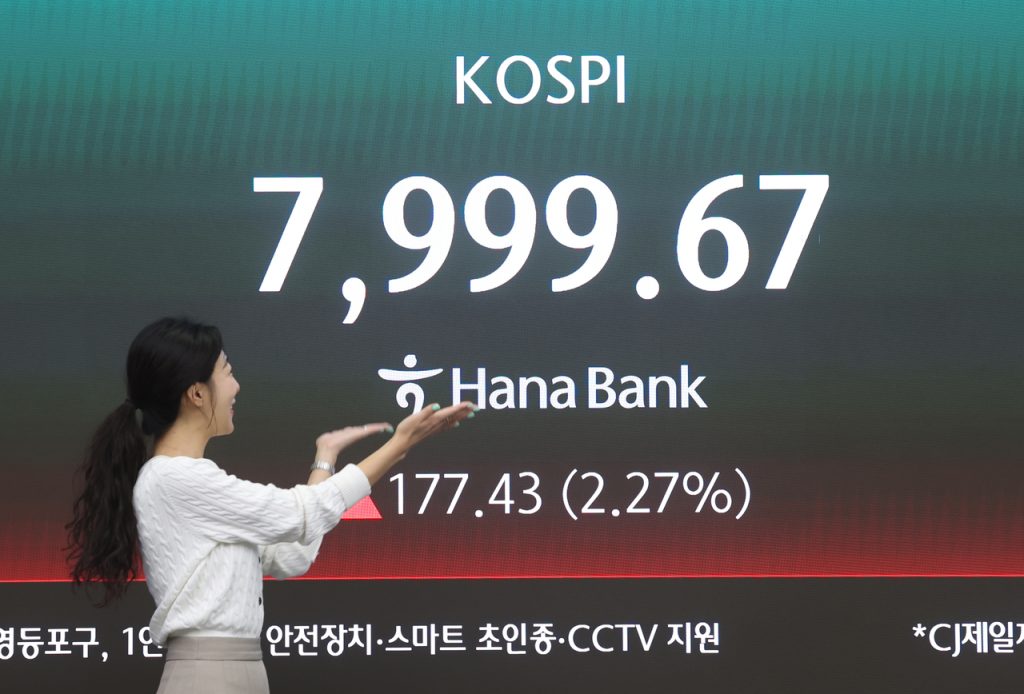
The index ultimately closed at 7,643.15, marking a 2.29 percent decline from its previous session. Although the Kospi initially surged to a high of 7,999.67 shortly after the opening bell, hovering just below the psychological 8,000 mark, the benchmark quickly reversed course. At one point, it plunged by 5.1 percent, reaching a low of 7,421.71.
Policy Aide’s AI Profit Dividend Proposal
Bloomberg highlighted that the Kospi’s sharp decline was directly influenced by recent remarks from Kim Yong-beom, the presidential chief of staff for policy. Kim’s comments focused on the substantial AI boom-related profits generated by leading South Korean chip giants, including Samsung Electronics and SK hynix.
“The gains from the AI era are not the result of a few specific companies, but were built on an industrial foundation that the entire nation has collectively developed over the past half-century,” Kim stated in a Facebook post on Monday. He further elaborated, “A portion of those gains should be structurally returned to all citizens,” advocating for the country to pay a “dividend” to its citizens, financed by taxes on these considerable AI-driven profits.
Market Reaction and Investor Outflows
Following its brief ascent to a fresh high near the 8,000 level, the Kospi rapidly reversed direction and plummeted. The downturn was primarily driven by foreign investors, who engaged in substantial profit-taking, offloading 5.6 trillion won (approximately $3.8 billion) worth of shares on the main board. Institutional investors also contributed to the selling pressure with net sales of 1.21 trillion won. Despite retail investors’ net buying of 6.68 trillion won, it was insufficient to offset the significant outflows from foreign and institutional players.
“The comments in a Facebook post by presidential policy chief Kim Yong-beom fueled sharp swings in Korean stocks on Tuesday as investors struggled to parse the scope of Kim’s proposals,” Bloomberg noted, underscoring the market’s uncertainty.
Clarification and Lingering Concerns
The benchmark Kospi managed to pare some losses, closing in the 7,600 range, after Kim clarified his remarks. He explained that he was referring to the utilization of excess tax revenue generated from the AI boom, rather than proposing a new windfall tax on corporate profits. However, this clarification proved insufficient to fully restore earlier market momentum or investor confidence.
Shares of major tech companies were also affected. Samsung Electronics closed at 279,000 won, down 2.28 percent, while SK hynix ended at 1.835 million won, down 2.39 percent, despite both stocks touching fresh highs in early trading.
Bloomberg also pointed out growing concerns, particularly within Korea, with increasing public calls for industry leaders like SK hynix and Samsung Electronics to share more of the gains from the AI boom. These calls are emerging alongside attention to labor tensions, including a recent strike at Samsung Electronics, adding to the complex landscape for these companies.
Presidential Office Distances Itself from Remarks
In a crucial development, the presidential office swiftly distanced itself from Kim’s remarks, clarifying that his comments do not represent the administration’s official position. “The content posted by the policy chief on social media is an individual opinion unrelated to internal discussions or reviews within the presidential office,” it stated in a press statement, aiming to mitigate further market impact and policy ambiguity.
silverstar


