
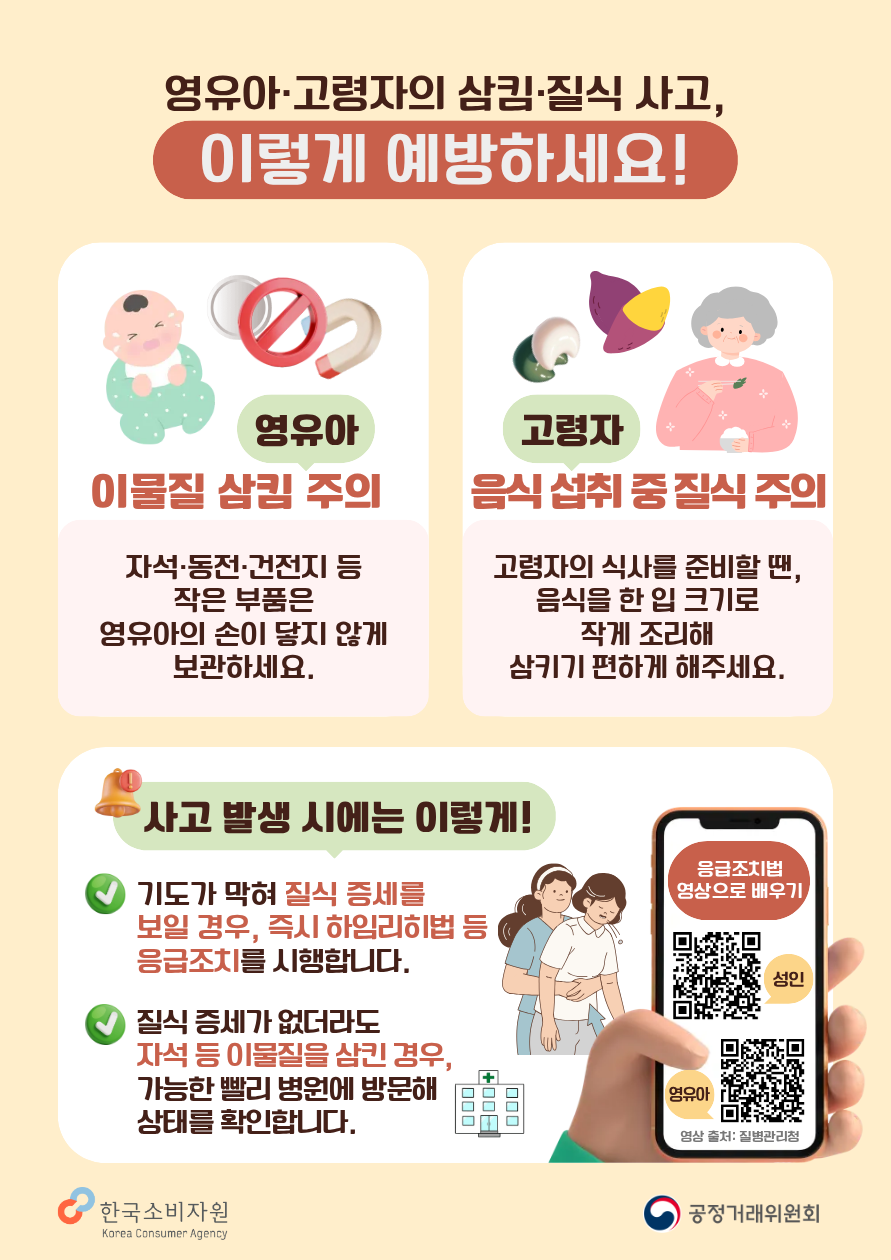
The **Fair Trade Commission (FTC)** and the **Korea Consumer Agency (KCA)** have jointly issued a critical **consumer safety alert** following a concerning rise in **swallowing and choking accidents**, particularly affecting vulnerable populations like **infants, young children, and older adults**.
Data compiled by the **Korea Consumer Agency’s Consumer Injury Surveillance System** reveals a significant trend: over the last five years, a total of 4,113 incidents of **foreign-object ingestion** were reported. A striking 67.6 percent of these **child safety incidents** involved children aged 7 or younger.
Analyzing the age distribution further underscores the risk to very young children. One-year-olds represent the largest demographic, accounting for 25.2 percent of cases. Infants under age 1 followed closely at 17.5 percent, with two-year-olds making up 13.6 percent. This means **more than half of all reported swallowing accidents involved children aged 2 or younger**, a group prone to exploring objects by putting them in their mouths.
Among the most frequently identified **hazardous items** leading to these accidents were **magnets**, responsible for 13.8 percent of cases. **Toys** contributed to 10 percent of incidents, and **coins** to 9.6 percent. Other dangerous objects included **marbles, stickers, and batteries**. Authorities emphasize that the ingestion of such items can lead to severe health complications, including internal injuries like **intestinal perforation** and life-threatening **airway obstruction**.
**Older adults** also face a substantial **choking risk** primarily due to age-related physiological changes. These include a natural decline in physical functions and weakened protective reflexes, such as a diminished cough reflex, which can compromise their ability to clear their airways effectively.
Illustrating the severity for seniors, authorities highlighted tragic cases where **elderly individuals** succumbed to **choking on common foods** like rice cakes and sweet potatoes, or lost consciousness while eating tangerines. Complementing this, data from the **National Fire Agency** shows that 1,196 patients required emergency transport over the past five years after experiencing **airway blockage during meals**.
In response to these alarming statistics, the **Fair Trade Commission** and the **Korea Consumer Agency** have released vital **consumer safety advice**. They urge caregivers to keep **small, hazardous objects** such as magnets and coins well out of **children’s reach**. For **older adults**, they recommend preparing food in easily manageable, **bite-sized pieces** and encouraging slower chewing and swallowing habits. Furthermore, they stress the importance of immediate action during a **choking emergency**, advising everyone to be prepared to perform life-saving interventions like the **Heimlich maneuver**.
jwjeon7625


