
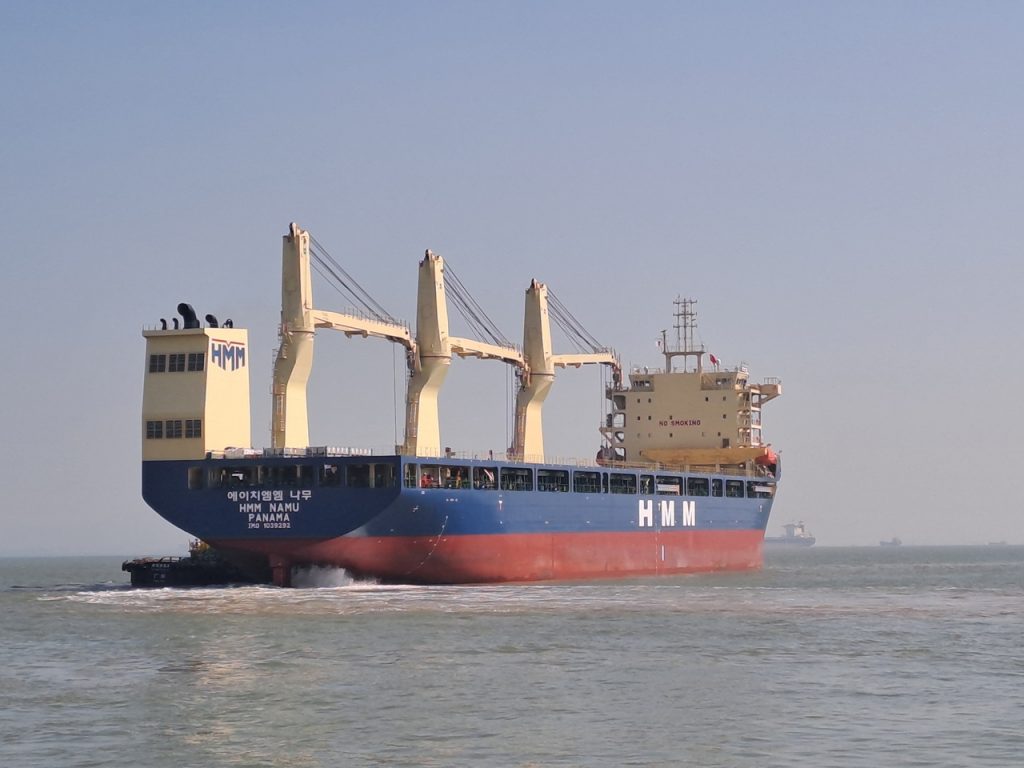
The **bulk carrier Namu**, a vessel operated by a South Korean company, is anticipated to reach **Dubai Port** by late Thursday (Korean time) following significant damage from an **explosion and fire in the Strait of Hormuz**. Upon its arrival, maritime investigators will commence a thorough examination to determine the precise cause of the incident, which has drawn international attention.
Known as the **Panama-flagged Namu**, this crucial vessel, managed by the prominent South Korean shipping giant **HMM**, has been stranded near the strategically vital **Strait of Hormuz** since May 4. The disabling incident involved an **engine-room explosion** that subsequently ignited a fire onboard, as confirmed by company officials.
**HMM** announced that towing operations for the **damaged bulk carrier** were slated to commence at 11 a.m. Thursday, though the precise departure timetable required further confirmation. The company projects the **vessel’s arrival** at a **Dubai repair yard** either late Thursday or early Friday, based on Korean Standard Time, for necessary repairs and further investigation.
In response to the serious maritime incident, **South Korea** is actively deploying a team of specialized investigators from both the **Korea Maritime Safety Tribunal** and the **National Fire Agency**, underscoring the nation’s commitment to understanding the incident.
The comprehensive inquiry by authorities will primarily delve into the definitive **cause of the fire** onboard the **Namu**. This investigation also addresses significant claims made by **US President Donald Trump**, who suggested the **vessel was ‘hit by Iran.’** President Trump further speculated that the **ship** might have undertaken ‘independent action’ while transiting the **Strait of Hormuz**, a globally critical **commercial shipping corridor** that has experienced considerable disruptions since a conflict involving Iran commenced on February 28.
**HMM** has explicitly refuted these allegations, stating that the **Namu** was merely awaiting the lifting of passage restrictions near a designated control line and had not, in fact, entered any expanded restricted zone within the **Strait of Hormuz**.
Furthermore, **HMM** highlighted that at the time of the incident, numerous other vessels, including four additional ships under **HMM**’s operation, were present in the immediate vicinity. This high volume of traffic strongly suggests it is improbable the **Namu** was operating in isolation or conducting ‘independent action’.
Mirroring the operator’s stance, the **South Korean government** has adopted a measured and cautious approach. Officials have indicated they will await the conclusive findings from the **maritime investigators** regarding the **cause of the fire** before formulating any official response to the complex **Strait of Hormuz incident**.
milaya


