
South Korea’s initial investment plans for the United States, formalized under a recent bilateral trade agreement, are expected to be unveiled after a pivotal new law takes effect in June, announced Seoul’s Industry Minister Kim Jung-kwan on Wednesday.
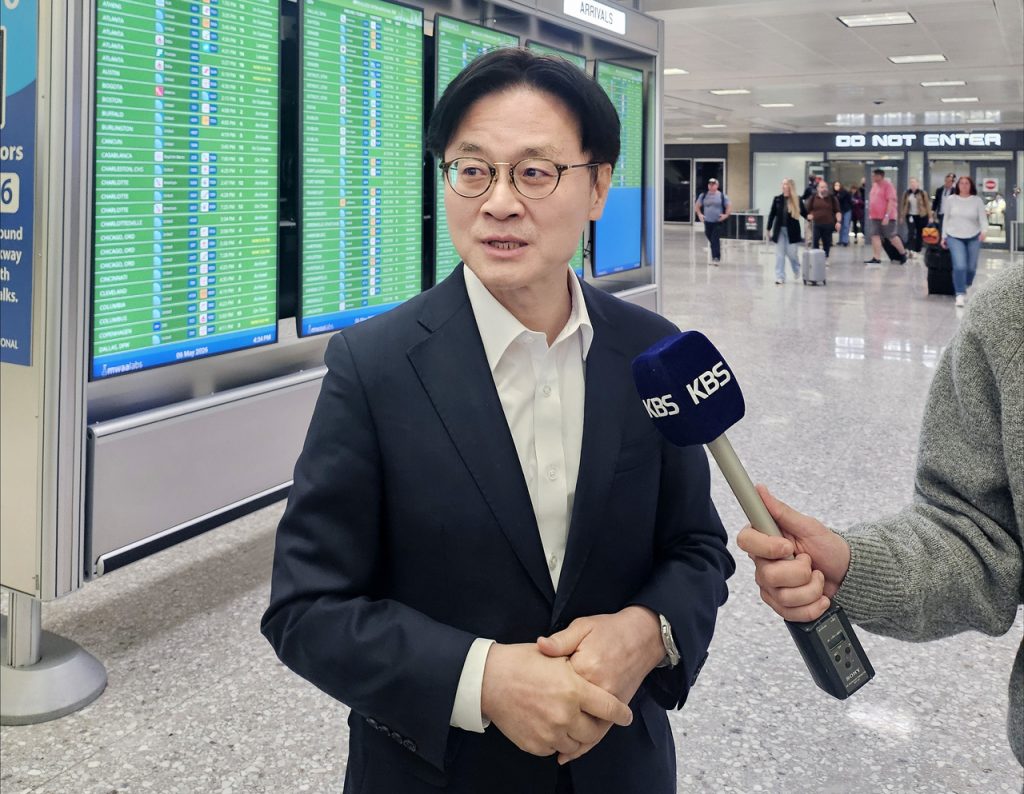
Minister Kim shared these developments during a press briefing held upon his arrival at an airport near Washington. The two nations are actively discussing these significant investment initiatives, which stem from last year’s comprehensive trade agreement. This landmark deal obligates Seoul to inject a substantial $350 billion into the U.S. economy, capped at $20 billion annually.
Addressing the timeline for concrete projects, Kim stated, “As for specific investment projects, we may be able to discuss them after the law takes effect in June.” He was referring to the crucial investment legislation scheduled to become effective on June 18.
South Korea’s National Assembly previously passed this vital investment act in March, specifically designed to streamline and encourage Korean investment into the United States.
The minister also addressed and dismissed criticisms suggesting that South Korea is lagging behind Japan in fulfilling its investment commitments to the U.S. Japan has already announced its initial investment ventures as part of a separate deal with Washington, pledging a substantial $550 billion.
Kim clarified his stance, stating, “Just because specific projects are announced, they don’t simply proceed. They should be implemented in detail.” He added, “I am not sure we can say that Korea is indeed behind Japan in terms of actual implementation.”
When questioned about the potential designation of a liquefied natural gas (LNG) export terminal construction project in Louisiana as the inaugural investment, the minister confirmed it is under active consideration. However, he emphasized that both nations have not yet reached a stage where they can definitively declare it as the first official project.
Shifting to the U.S.’ ongoing trade investigations, conducted under Section 301 of the 1974 Trade Act, Minister Kim explained these probes aim to reinstate country-specific “reciprocal” tariffs. These tariffs were previously invalidated by a Supreme Court ruling in February. Prior to this court decision, South Korean products faced a 15 percent reciprocal tariff.
Kim anticipated, “As a result of the investigations, I anticipate the tariff might be within that 15 percent range.” He further assured, “We will make our best efforts to ensure that the tariff will remain within that range.”


