
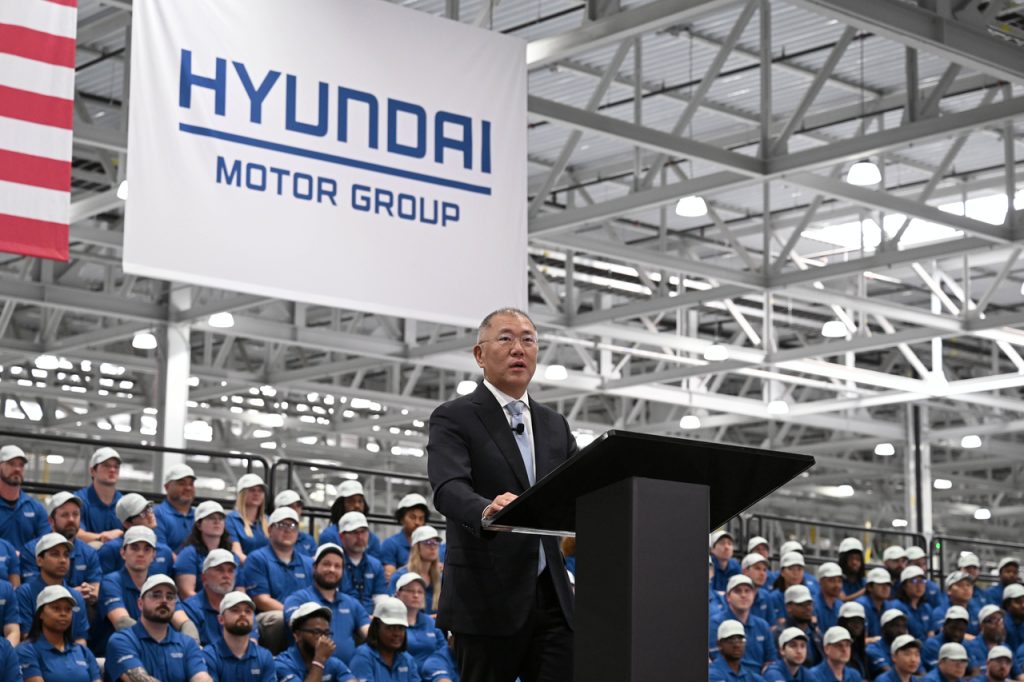
Higher tariffs may widen price gap with European rivals, fueling US growth for Genesis, hybrid SUVs
Following months of navigating **US tariff headwinds**, where **Hyundai Motor Group** strategically prioritized market share over immediate margins, the competitive landscape in the **world’s second-largest auto market** is poised for a significant shift. Washington’s recent move to increase **tariffs on European vehicles** is set to reshape dynamics for the **automotive industry**.
On Friday, **US President Donald Trump** announced plans to significantly **increase tariffs on European cars and trucks** from 15 percent to 25 percent, effective later this week. The move comes amid accusations that the **European Union** has failed to adhere to a prior trade agreement, with President Trump urging the bloc to boost its manufacturing presence within the **United States**.
This tariff adjustment unfolds against a backdrop of escalating tensions between **Washington and Brussels**, encompassing various trade disputes and disagreements over US troop levels in Germany. The decision further contributes to **global uncertainty**, already amplified by the ongoing Middle East crisis.
Experts anticipate this **tariff shift** will fundamentally alter **pricing dynamics** across the **US auto market**. It is projected to widen the price gap between **European vehicle imports** and well-established market competitors, notably **Hyundai Motor and Kia**, both of whom have significantly expanded their **market presence** in recent years.
Over the last decade, **Hyundai Motor Group** has notably strengthened its **foothold in the US auto market**, consistently gaining ground against Europe’s established legacy automakers.
A significant milestone occurred in 2011 when combined **US sales of Hyundai and Kia** exceeded 1 million units for the first time, surpassing the collective performance of five major **European luxury and mainstream brands**: **Mercedes-Benz, BMW, Audi, Volkswagen, and Volvo**.
Even under the previous 15 percent tariff regime, **Hyundai and Kia** achieved remarkable success, selling a combined **1.84 million vehicles in the US** last year. This represented a 7.5 percent year-on-year increase, setting a new **sales record** and securing an impressive **11.3 percent US market share**. The sales gap against the aforementioned five **European brands** expanded significantly to approximately 488,000 vehicles.
This market divergence is even more evident when examining **US auto imports**. According to analysis from Korea Investment & Securities, **Korean-made vehicles** commanded an 8.3 percent share of **US auto imports**, totaling around 1.35 million units. This contrasts with approximately 5 percent, or 820,000 units, for **European brands imports**, primarily led by **Volkswagen, Mercedes-Benz, and BMW**.
Limited but Meaningful Upside for Hyundai Motor Group
While **industry analysts** acknowledge the potential impact, they suggest the proposed **tariff hike** may not immediately trigger a dramatic shift in demand away from **European luxury brands**. This is primarily due to their comparatively smaller share of **US imports** and their robust, entrenched positioning within the **premium automotive segment**.
Nevertheless, the strategic move is widely anticipated to bolster **Hyundai Motor Group’s pricing power** across various segments.
“While the direct impact on volumes may be limited, the shift is nonetheless positive from a pricing perspective,” said Kim Chang-ho, an analyst at Korea Investment & Securities.
The most significant potential upside for **Hyundai Motor Group** is observed within the **luxury automotive segment**, traditionally dominated by **European brands**. **Genesis**, Hyundai’s rapidly growing **premium brand**, is well-positioned to gain substantial ground as these **higher tariffs** are expected to significantly erode the **price competitiveness** of key rivals like **Mercedes-Benz, BMW, and Audi**.
Last year, **Genesis** recorded impressive **sales of 82,332 vehicles in the US**, marking a 9.8 percent increase and contributing 8.4 percent to **Hyundai Motor Group’s total US sales**.
However, automotive experts caution that established **brand strength** and perception for **Genesis** within the premium space could still present a hurdle.
“**Genesis** could target Audi at best, but it is still difficult to challenge **Mercedes-Benz and BMW**, which have deeply entrenched customer bases,” said Lee Ho-geun, an automotive engineering professor.
Professor Lee further suggested that the most immediate competitive intensification for **Hyundai and Kia** is likely to occur with **mid-tier European brands** such as **Volkswagen and Volvo**.
“If **tariffs on European cars** rise, **Hyundai and Kia** will gain a relative price edge over **Volkswagen** across popular segments including both **sedans and SUVs**, which could support **sales growth**,” explained Lee.
Furthermore, **Hyundai Motor Group** is increasingly competing directly with **Volvo** in the lucrative **SUV segment**, leveraging significant advancements in vehicle **safety and value positioning**.
Concurrently, **Hyundai Motor Group** possesses a distinct **structural advantage in hybrid vehicles**, a segment experiencing exceptionally **rapid growth in the US auto market**. This contrasts sharply with many **European rivals**, whose limited electrified offerings often remain primarily focused on **plug-in hybrid models**.
In the first quarter, **Hyundai** achieved a record **hybrid share** of 17.8 percent, with **173,977 hybrid vehicles sold**. Meanwhile, **Kia’s hybrid models** accounted for a substantial 35 percent of its total sales, amounting to **49,593 units**.
This **hybrid momentum** accelerated even further in April, as combined **sales by Hyundai and Kia** for hybrid vehicles **surged 57.8 percent year-on-year** to reach 41,239 units. This impressive growth was spearheaded by popular **Hyundai models** such as the Palisade, Santa Fe, Tucson, and Sonata, alongside key **Kia models** including the Telluride, Sorento, and Sportage.
hyejin2


