
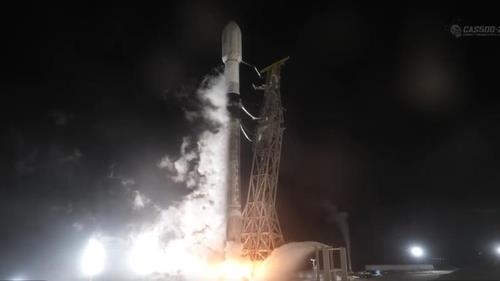
South Korea’s advanced Earth-observation satellite, the CAS500-2, has successfully achieved low-Earth orbit following its recent launch from a U.S. space facility in California. This significant milestone, announced by authorities on Sunday, is poised to significantly enhance Seoul’s burgeoning satellite development capabilities and reinforce its position in global space technology.
The successful deployment was carried out by a SpaceX Falcon 9 rocket, which majestically lifted off at precisely 12 a.m. Saturday (US time) from the Vandenberg Space Force Base, located in Santa Barbara County, California. The powerful launch marked a pivotal moment for South Korea’s space endeavors.
Known as the Compact Advanced Satellite (CAS) 500-2, this sophisticated spacecraft detached from its launch vehicle approximately one hour after liftoff. The Korea AeroSpace Administration (KASA) confirmed that the satellite was successfully inserted into its designated orbit, commencing its critical mission.
Further affirming its operational readiness, the next-generation midsized satellite No. 2 successfully established its initial communication with a ground station situated in Norway. This crucial contact occurred roughly 15 minutes after its separation from the rocket, with KASA promptly verifying the satellite’s normal functioning and stable operational status.
The CAS500-2 satellite is specifically engineered for vital roles in disaster monitoring and agricultural observation, providing invaluable data for both environmental protection and food security. Following an initial four-month operational period, the CAS500-2 will begin its collaborative mission alongside its counterpart, the CAS500-1, starting in the latter half of this year.
Originally, the CAS500-2 was slated for a 2022 launch aboard a Russian Soyuz rocket. However, its deployment faced an unforeseen delay following Russia’s invasion of Ukraine, necessitating a change in launch provider and schedule.
Weighing 534 kilograms, the CAS500-2 boasts impressive high-resolution Earth observation capabilities. It can capture incredibly detailed black-and-white images with a ground resolution of 0.5 meters, alongside sharp color images at 2 meters resolution, offering superior data for its diverse applications.
KASA proudly highlighted that the core components of the CAS500-2 platform and its advanced payload were developed entirely with homegrown South Korean technology. This successful satellite launch not only demonstrates robust engineering prowess but also significantly strengthens South Korea’s space technology independence, marking a new era for its national space program.


