

The U.S. Trade Representative (USTR) has intensified its criticism of South Korea’s controversial network usage fee policy, branding it as a significant global outlier and one of the most ‘crazy’ foreign trade barriers impacting American exporters.
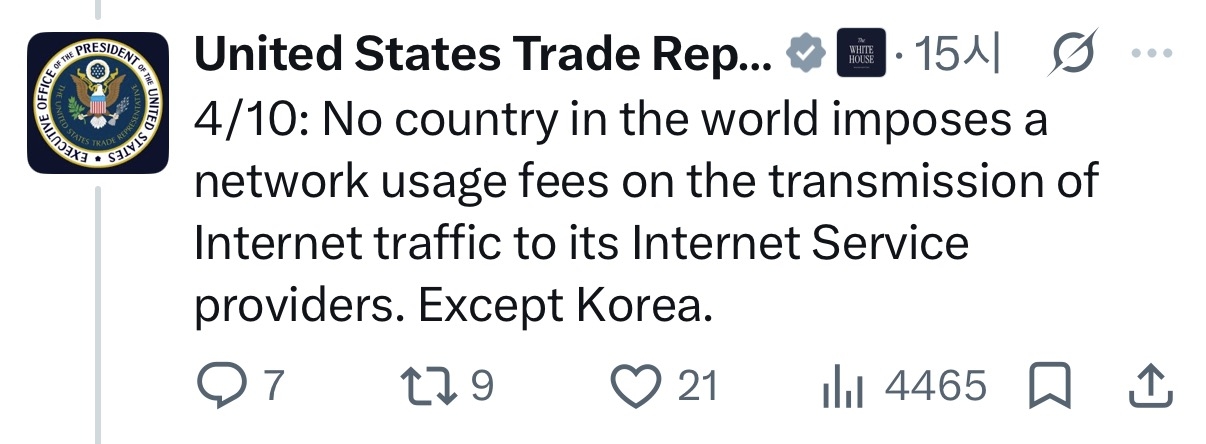
In recent posts on X (formerly Twitter), the USTR highlighted this policy as a prime example of extreme measures taken by countries to hinder American exports. South Korea’s ‘sending party network pays’ policy, unique globally, was ranked fourth among 10 such trade barriers. The USTR emphatically stated, “No country in the world imposes network usage fees on the transmission of Internet traffic to its Internet Service Providers. Except Korea.”
Washington has consistently classified this controversial policy as a non-tariff barrier, a stance reiterated in the USTR’s annual National Trade Estimate report. The latest report, published last month, specifically grouped Korea’s network fee policy with broader digital trade concerns, including platform regulation, cross-border data restrictions, and complex digital payment certification requirements.
This ongoing dispute underscores a fundamental clash between major telecom operators and global content providers regarding the equitable distribution of costs associated with surging internet data traffic.
Leading Korean telecom carriers, including SK Telecom and KT Corporation, contend that major foreign streaming and content platforms like Netflix and YouTube generate immense network traffic but fail to contribute their fair share to infrastructure maintenance and expansion. They advocate for additional network usage fees to ensure equitable cost-sharing and foster sustained investment in digital infrastructure, pointing out that domestic platforms like Naver already bear similar charges.
Conversely, prominent US tech firms staunchly reject this perspective, asserting that end-users already pay for internet access, rendering additional network fees a form of double-billing. They also raise significant net neutrality concerns, cautioning that traffic-based charges could lead to discriminatory treatment of content and ultimately undermine the principles of an open internet.
The contentious issue remains under active legislative review in South Korea. The National Assembly is currently considering amendments to the Telecommunications Business Act, which, if passed, would mandate global tech firms to share network usage costs.
These recent remarks by the USTR indicate that the network usage fee dispute is likely to persist as a significant sticking point in bilateral trade discussions, especially as digital trade and platform regulation increasingly dominate international policy agendas.
Industry analysts speculate that the USTR’s strong criticism could be preparing the ground for broader trade enforcement actions under Section 301 of the Trade Act of 1974, potentially expanding investigations into digital services. Coinciding with these developments, the USTR is holding a public hearing this Tuesday at the US International Trade Commission, addressing concerns such as overcapacity and forced labor across approximately 60 nations, including South Korea. Another hearing on May 5 will further delve into overcapacity issues affecting 16 countries, again including Korea.
Despite these pressures, a Korean government official downplayed the likelihood of immediate punitive action, emphasizing that a formal network usage fee regime has not yet been implemented.
However, the official acknowledged, “it is difficult to rule out the possibility that a Section 301 investigation could be expanded to cover digital sectors,” highlighting increasing US scrutiny of non-tariff barriers within the burgeoning digital economy.
Beyond the Korean situation, the USTR’s recent communications also brought to light other significant trade frictions globally, such as Turkey’s ban on US rice imports, Nigeria’s restrictions on American beef, and Australia’s regulatory framework for video streaming platforms.


