
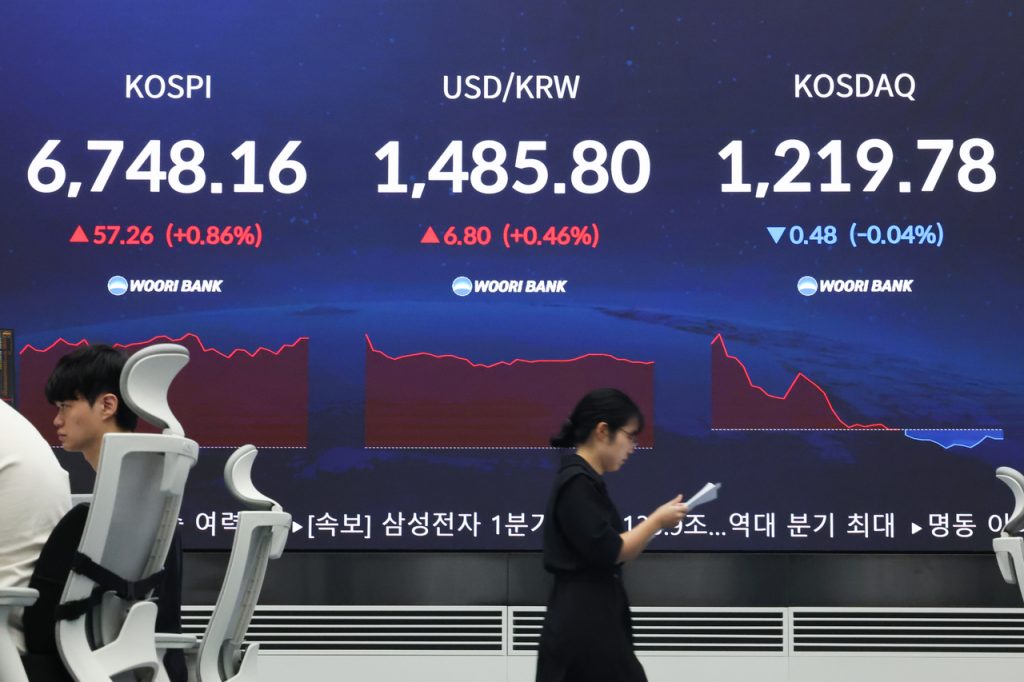
Seoul Stock Market Takes a Dip as Investors Cash In Gains Amid Surging Oil Prices
The Seoul stock market experienced a significant downturn Thursday, falling by over 1 percent and ending a three-day winning streak. This decline occurred after the benchmark index had initially touched a fresh all-time high, as investors engaged in profit-taking amidst a sharp rise in international oil prices.
Following a session of volatile trading, the benchmark Korea Composite Stock Price Index (Kospi) ultimately closed down by 92.03 points, a 1.38 percent drop, to settle at 6,598.87. This reversal came after the Kospi had earlier soared to an intraday high of 6,750.27.
Trading activity was robust, with a substantial volume of 676.2 million shares exchanging hands, totaling 34.7 trillion won (approximately $23.4 billion). The market saw a clear imbalance, with declining stocks significantly outnumbering gainers by a ratio of 666 to 193.
Foreign investors were net sellers, offloading 1.45 trillion won worth of South Korean equities. In contrast, domestic retail investors bought a net 1.19 trillion won, and institutional investors acquired 283.8 billion won, providing some counterbalancing demand.
The Kospi had initially opened on a positive note, buoyed by optimistic earnings reports. South Korean tech titan Samsung Electronics announced record quarterly earnings for the first quarter of the year. Concurrently, four major US tech companies — Alphabet, Amazon.com, Meta Platforms, and Microsoft — also exceeded expectations with their first-quarter results, collectively fueling strong hopes for the sustained boom in the artificial intelligence (AI) sector.
However, this early optimism was short-lived as the Kospi reversed course, succumbing to widespread profit-taking and persistent concerns stemming from the ongoing conflict in the Middle East.
The market’s downturn was significantly exacerbated by a sharp surge in international oil prices. Brent crude, the global oil benchmark, climbed dramatically by 6.1 percent to reach $118.03 per barrel. Similarly, the West Texas Intermediate (WTI) price saw a substantial jump of 6.95 percent, closing at $106.88 per barrel. This escalation followed a statement from US President Donald Trump, who declared he would maintain a naval blockade on Iran until a comprehensive nuclear deal with Tehran is successfully secured.
Adding to the cautious sentiment, major US stock indexes concluded the previous overnight session with mixed results. The Dow Jones Industrial Average recorded a 0.57 percent decline, and the S&P 500 edged down by 0.04 percent. In contrast, the tech-heavy Nasdaq composite managed a slight gain of 0.04 percent.
The market’s decline was further influenced by the recent decision from the US Federal Reserve to maintain its benchmark interest rate within the 3.5-3.75 percent range for the third consecutive meeting. This point was highlighted by Lee Kyoung-min, an analyst at Daishin Securities.
“Investor appetite diminished as market participants interpreted the outcome of the latest Federal Open Market Committee (FOMC) meeting as signaling a more hawkish stance,” Lee explained.
The Federal Reserve’s decision to keep rates unchanged was primarily attributed to “elevated” inflation levels and a “high level” of persistent economic uncertainty, largely stemming from the ongoing Middle East crisis.
Across the board, most big-cap shares on the Kospi recorded losses.
Samsung Electronics, renowned as the world’s leading memory chipmaker, initially saw its shares rise following a robust earnings report but ultimately closed 2.43 percent lower at 220,500 won. Its key chipmaking competitor, SK hynix, also declined, losing 0.54 percent to 1.29 million won.
In the automotive sector, leading automaker Hyundai Motor slid by 4.5 percent, ending at 531,000 won, while its affiliate Kia also saw a decline of 3.25 percent, closing at 151,800 won.
Prominent battery manufacturers also faced headwinds: LG Energy Solution dipped 2.64 percent to 460,500 won, and its competitor Samsung SDI dropped 2.39 percent to 695,000 won.
Conversely, select electrical component shares managed to gain ground. Samsung Electro-Mechanics advanced by 0.6 percent to 832,000 won, and LS Electric saw a rise of 1.83 percent, reaching 278,000 won.
In notable individual performances, Doosan Robotics saw a significant surge of 7.83 percent, fueled by news of its potential technology cooperation with AI chip industry leader Nvidia. Additionally, K-pop entertainment giant Hybe experienced a strong jump of 4.16 percent, closing at 263,000 won, on the back of its robust first-quarter earnings report.


