
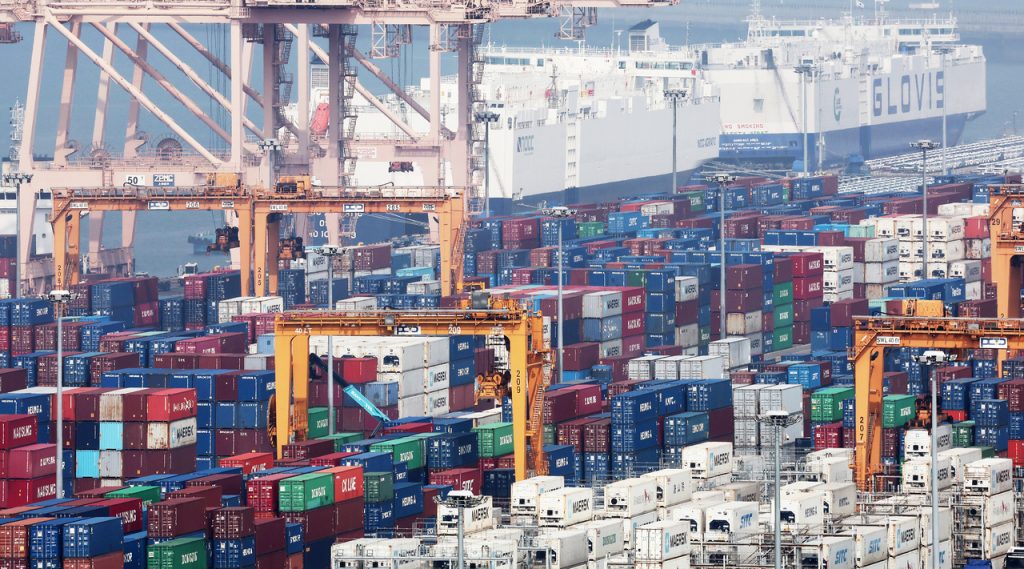
South Korea’s economy showcased a significant upturn in March, as official data released Thursday confirmed month-on-month increases across key economic indicators: industrial output, retail sales, and facility investment.
This robust performance marked the first occasion since last September that all three vital economic gauges posted simultaneous on-month growth, signaling a potential recovery trend for the nation’s economy.
Industrial production in South Korea edged up 0.3 percent last month, registering its second consecutive month of increase. According to the Ministry of Data and Statistics, this resilience was observed despite external factors.
Ministry officials highlighted that the broader economic impact of the Middle East crisis, which began in late February, had not yet visibly affected the overall production trends. Lee Doo-won, a ministry official, stated, “Despite the Middle East war, the overall trend in production remains intact,” though he anticipates the effects could become more apparent in April and May.
Breaking down the industrial performance, the crucial mining and manufacturing sector recorded a 0.3 percent rise from the previous month. This growth was primarily fueled by strong output in the automotive industry, other transportation equipment, and general machinery production.
However, semiconductor production experienced an 8.1 percent decline from the preceding month. This dip was largely attributed to a base effect following an exceptional 28.2 percent surge in February, despite sustained global demand driven by the artificial intelligence boom. Additionally, the production of refined petroleum products saw a 6.3 percent decrease, directly impacted by the ongoing Middle East conflict.
In terms of private spending, retail sales, a key barometer of consumer activity, recorded a healthy 1.8 percent increase over the cited period, the ministry reported.
Within retail sales, semidurable goods, such as apparel and clothing, saw a modest rise of 0.3 percent. More notably, durable goods, including essential home appliances, jumped by a substantial 9.8 percent. Conversely, sales of nondurable goods, including everyday food and beverages, experienced a slight dip of 1.3 percent.
Commenting on the consumer landscape, official Lee Doo-won remarked, “Consumption, which has been weak over the past three years, appears to be bottoming out and beginning to recover,” suggesting an optimistic outlook for future consumer spending and economic rebound in South Korea.


