
The United States government has intensified its criticism of **South Korea’s network usage fee policy**, highlighting an ongoing point of contention in bilateral trade relations.
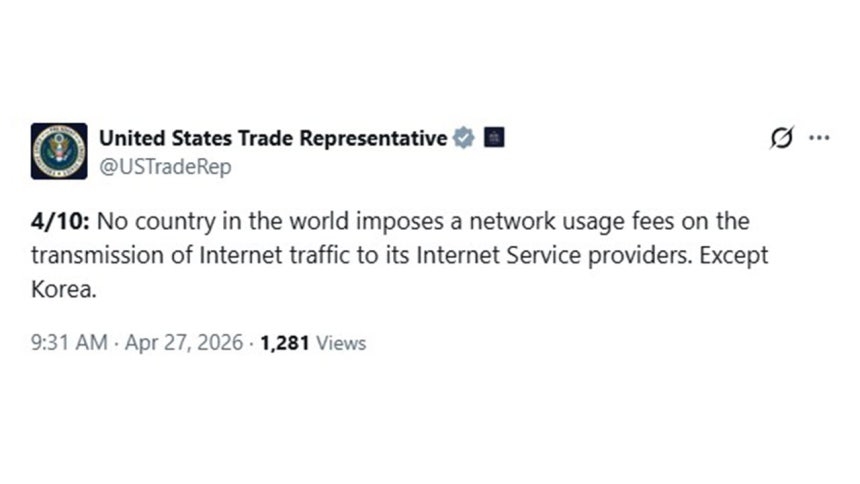
The Office of the United States Trade Representative (USTR) recently stated via a post on X (formerly Twitter) that **South Korea** is uniquely imposing **network usage fees** on the transmission of **internet traffic** by its internet service providers, claiming this practice is unparalleled globally.
Washington has consistently categorized this specific **Korean network fee policy** as a significant **non-tariff barrier**. The contentious issue has been a recurring highlight in the USTR’s annual National Trade Estimate Report, which details various obstacles encountered by American businesses operating abroad.
The USTR’s latest report, published on March 31, once again singled out **South Korea’s network usage fees** as a barrier within the services sector. It was listed alongside other concerns such as proposed platform regulations, limitations on cross-border transfers of location-based data, and stringent certification and security mandates affecting payment services.
These recent remarks by the USTR were part of a series of social media posts collectively titled “Craziest Foreign Trade Barriers Facing American Exporters.” The campaign aimed to draw attention to various global obstacles for U.S. firms, with an introductory message urging readers to ‘review a list of 10 cases.’ **South Korea’s network usage fee policy** was notably highlighted as the fourth item on this list.
The **network usage fee issue** remains a fiercely debated topic.
**South Korean telecom operators**, including industry giants SK Telecom and KT Corp., advocate for **network fees** on large **content providers**. They assert that such charges are essential for fairness, citing the substantial increase in **network maintenance costs** due to surging data traffic, largely fueled by global streaming platforms and other online services.
Conversely, major **US technology companies** like **Netflix and YouTube** argue that these **South Korean network fees** constitute **double charging**, given that end-users already subscribe and pay for internet access. They further contend that implementing differential charges based on traffic volume fundamentally opposes the principle of **net neutrality**, which mandates equitable treatment for all online data flows.
This article was produced with the assistance of AI. — Ed.
milaya


