

The burgeoning artificial intelligence (AI) capital spending boom is extending beyond memory and logic chips, significantly impacting the crucial component tier of the global supply chain. In this high-growth sector, Samsung Electro-Mechanics has emerged as a key Korean player, demonstrating clear leverage and strategic importance.
Reflecting strong investor confidence, shares of the Samsung group affiliate saw a remarkable surge of 93.37 percent between March 31 and April 24. Korea Exchange data shows the stock closed Friday at 788,000 won ($536) after opening Monday at 792,000 won. Throughout April, Samsung Electro-Mechanics repeatedly set fresh peaks, hitting an intraday record of 816,000 won on April 22. This performance vastly outpaced the Kospi’s 28.17 percent gain and its electronics sub-index, which rose 31.42 percent over the identical period.
This impressive rally has propelled Samsung Electro-Mechanics’ market capitalization to 58.93 trillion won, positioning it at 12th on the Kospi as of Monday morning, within approximately 1 trillion won of Kia at No. 11.
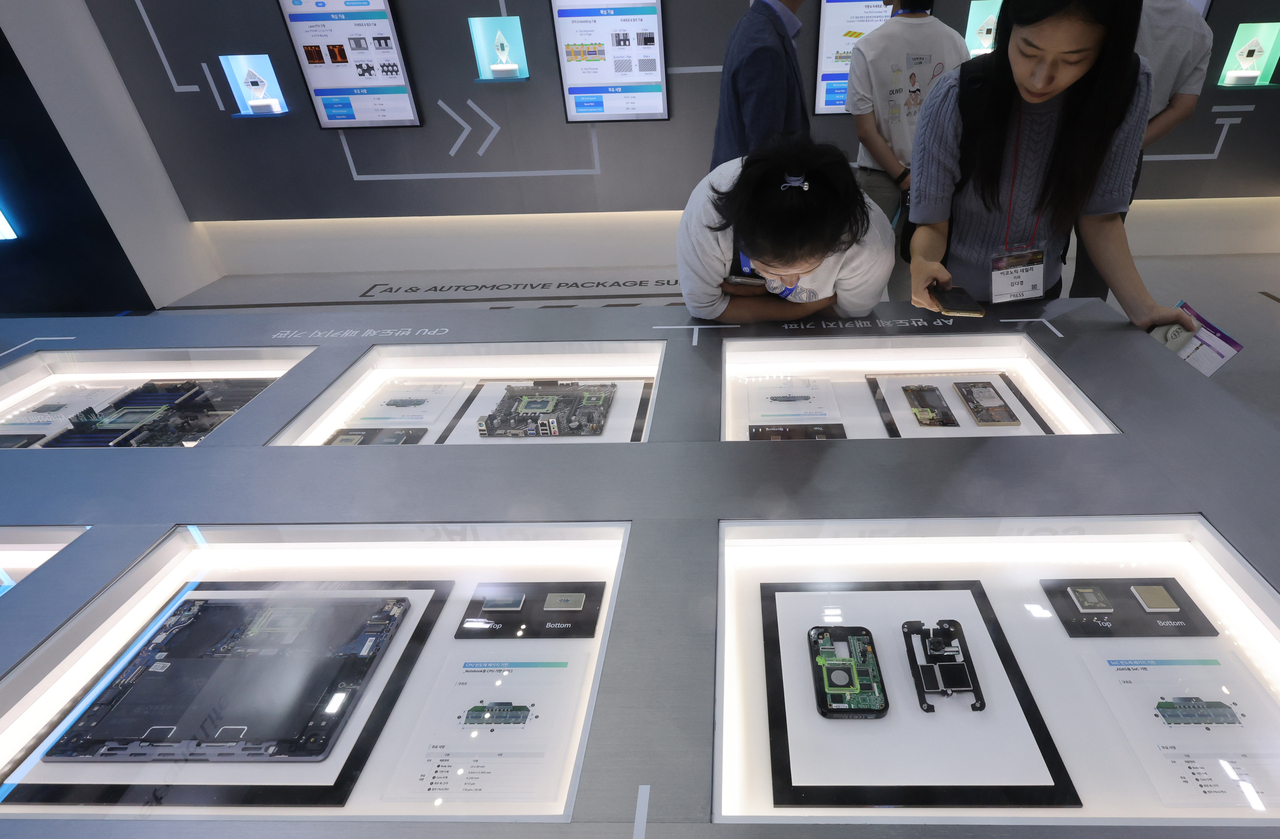
While often overshadowed by giants like Samsung Electronics and SK hynix in the broader AI landscape, Samsung Electro-Mechanics is now attracting significant investor attention. This is largely due to its expertise as one of the few global manufacturers capable of producing flip-chip ball-grid array (FC-BGA) substrates. These advanced packaging boards are vital for connecting high-performance AI accelerators and server processors to mainboards. As leading chip designers like Nvidia develop larger, multilayered packages for next-generation graphics processing units (GPUs), the complexity and production difficulty of these critical substrates have increased, concentrating capacity among a small group of specialized Japanese, Taiwanese, and Korean suppliers.
Furthermore, Samsung Electro-Mechanics shares a high-end duopoly in multilayer ceramic capacitors, or MLCCs, with Japan’s Murata Manufacturing. These tiny, yet essential, passive components are crucial for stabilizing power delivery in advanced electronics. AI servers, in particular, demand three to four times the MLCC content of conventional servers, often at unit prices three to five times higher, due to the stringent high-temperature and high-voltage tolerances required for optimal AI performance.
Both FC-BGA substrates and MLCCs are currently experiencing structural shortages, driven by the aggressive build-out of AI infrastructure by major tech players such including Nvidia, Google, Amazon, and Apple. CEO Chang Duck-hyun informed shareholders in March that customer demand for FC-BGA already exceeds the company’s current production capacity by more than 50 percent.
In a strategic move to capitalize on this demand, the company recently secured first-vendor status for FC-BGA substrates to be used in the Groq 3 language processing unit. This inference accelerator is slated for integration into Nvidia’s upcoming Vera Rubin platform, with mass production scheduled for the second quarter. To further expand its production capabilities for AI-related FC-BGA, Samsung Electro-Mechanics is investing approximately $1.2 billion at its Vietnam plant, having secured an investment certificate from Vietnamese authorities.
“A structural shortage in FC-BGA for AI servers and data centers is anticipated to persist throughout this year,” stated Park Kang-ho, an analyst at Daishin Securities. He projects that with continued strategic investment, Samsung Electro-Mechanics could “leap to the global No. 1 position” within this critical segment of the AI supply chain.
Echoing this positive outlook, Ko Eui-young at iM Securities highlighted that the increasing technical difficulty in MLCC production is “cementing the duopoly between Samsung Electro-Mechanics and Japan’s Murata.” Ko forecasts the company’s revenue from industrial MLCCs to more than double, reaching 2 trillion won by 2027 from an estimated 950 billion won this year.
The company is set to report its first-quarter earnings on Thursday.
mjh


