Elon Musk Confirms Samsung to Manufacture Upgraded AI4+ Self-Driving Chip for Tesla
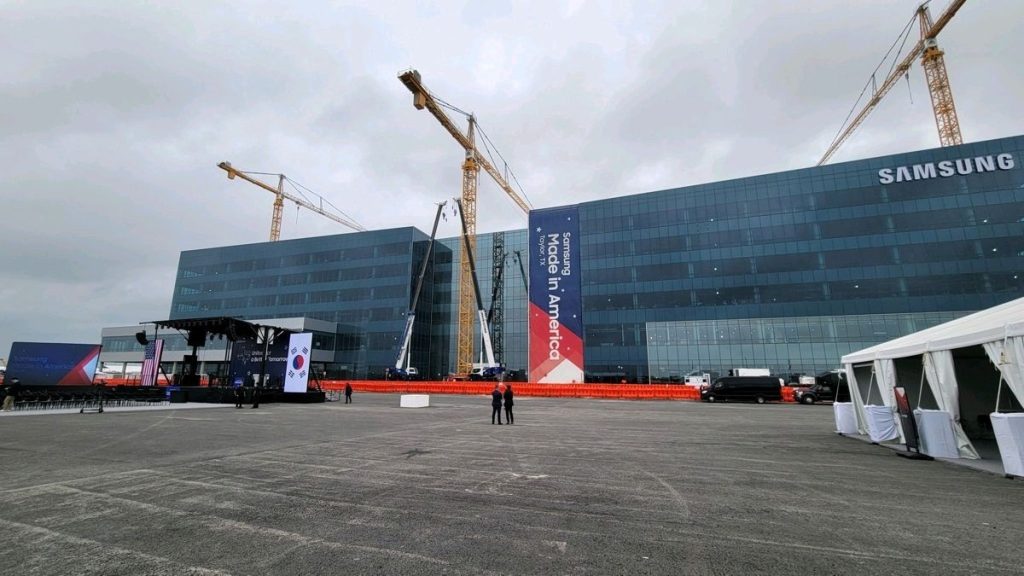
Samsung Electronics is set to host an equipment move-in ceremony at its state-of-the-art contract chip plant in Taylor, Texas, this Friday. This pivotal event marks the official installation of advanced chipmaking machinery, preparing the facility to commence silicon production for key clients like Tesla, among others, later this year.
The ceremony signifies the conclusion of a nearly two-year delay for the massive $37 billion facility, where Samsung broke ground in late 2022. This milestone also coincides with Tesla CEO Elon Musk’s recent confirmation regarding a third Samsung-manufactured chip being added to the Korean foundry’s dedicated production pipeline for Tesla.
Crucially, the Taylor plant represents Samsung’s strategic re-entry into the top echelon of contract chip manufacturing – the specialized business of producing semiconductors designed by external companies. Tesla’s significant orders, valued at an estimated 22.76 trillion won ($15.4 billion) under a contract inked in July 2025, already encompass the advanced AI5 and the cutting-edge, next-generation AI6 chips. These powerful processors are destined to power Tesla’s sophisticated self-driving software and its innovative Optimus humanoid robot.
High-profile attendees expected at the ceremony include Samsung foundry chief Han Jin-man, alongside key executives from leading chipmaking equipment suppliers such as ASML and Lam Research, underscoring the industry-wide significance of this event.
This week, Elon Musk further expanded Tesla’s chip portfolio, confirming the addition of a new chip internally designated as AI4+ or AI4.1. This advanced processor serves as an upgraded iteration of the AI4 currently integrated into Tesla vehicles, boasting enhanced memory capabilities, wider bandwidth, and superior computational power. During Tesla’s first-quarter earnings call on Wednesday, Musk revealed that Samsung is currently refining the design for AI4+ production, targeting a mid-2027 rollout.
“Samsung is doing a revision on the chip,” Musk informed analysts, strategically positioning AI4+ as a vital bridge. This interim solution enables Tesla to maintain operational continuity for its existing production lines, particularly as the significantly more powerful AI5 chip – which finalized its design on April 15 – is initially prioritized for the Optimus robot and Tesla’s AI data centers. With AI5 being approximately five to ten times faster than the current AI4 architecture, it is considered over-engineered for automotive applications in the immediate future.
“It may make sense to transition to AI5 for vehicles at some point, but it’s not urgent right now,” Musk elaborated. He further stated, “If AI4 hardware becomes too outdated, it could end up being the only reason to keep factories running,” highlighting the importance of the AI4+ upgrade for sustained vehicle production efficiency.
Notably, all three of Tesla’s advanced chips – AI4+, AI5, and AI6 – will leverage Samsung’s cutting-edge 2-nanometer gate-all-around (GAA) process at the Taylor fabrication plant. This represents the company’s most advanced chipmaking technology. While Samsung will collaborate with Taiwan’s TSMC, the world’s largest contract chipmaker, on a portion of AI5 production, it will hold exclusive manufacturing rights for the groundbreaking AI6 chip.
The significant commercial stakes are concentrated within Samsung’s foundry division, which has, according to local reports, registered substantial quarterly losses, estimated at approximately 1 trillion won since 2022. However, internal industry sources indicate that Samsung has aggressively moved its break-even target forward to the fourth quarter of this year, a considerable acceleration from its previous 2027 goal. The achievement of this ambitious target hinges critically on the Taylor plant’s ability to rapidly enhance its yield – the percentage of usable chips produced from each wafer. Current industry estimates place Samsung’s 2nm yield between 50 and 60 percent, which still lags behind TSMC’s reported 80 to 90 percent, highlighting an ongoing challenge.
mjh